
Sciatica
Pain travelling from the back or buttock down the leg, usually because a nerve going to the leg is irritated or compressed. Most cases settle, but it takes weeks to months.
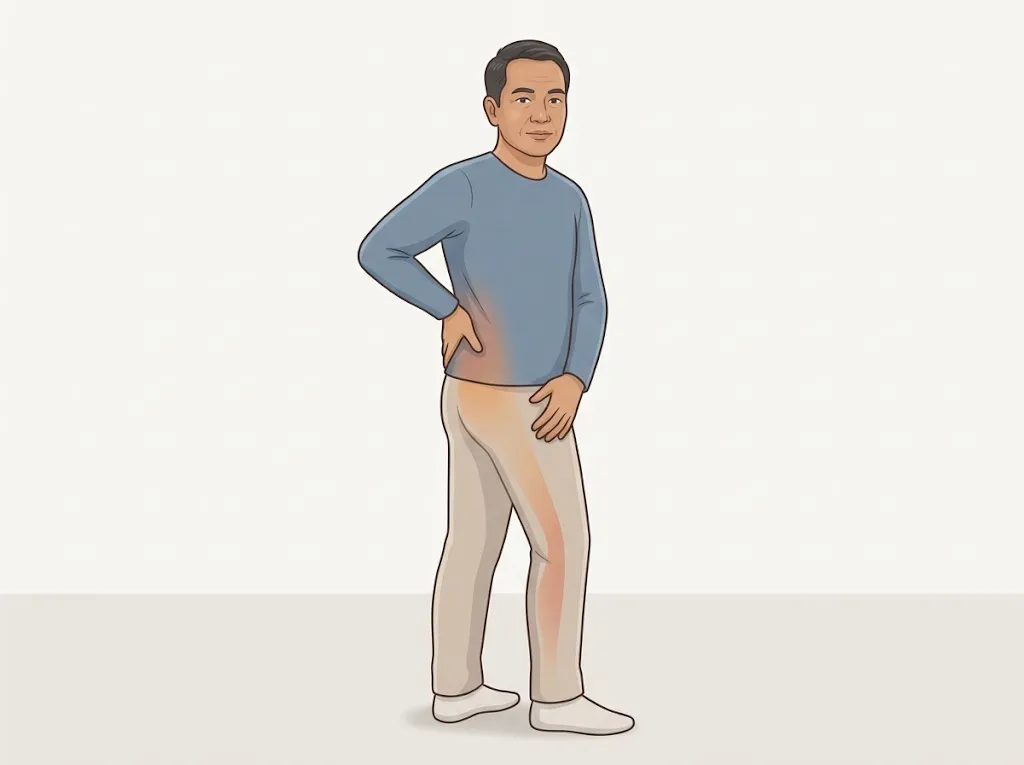
What it is
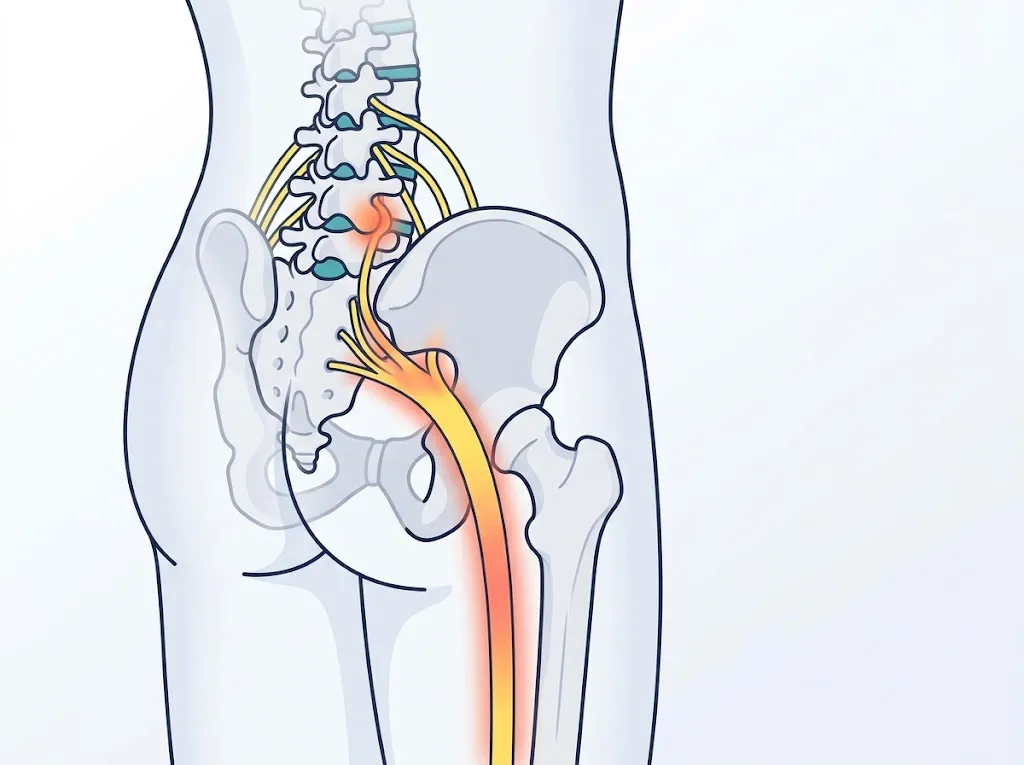
The nerves that supply your leg leave the spinal cord in the lower back, then join into a large nerve running down the back of the leg. When those nerves are compressed or irritated, you feel pain along the whole path they supply — not just where the problem is.
That is why the problem is in your back but you feel it in your calf or your foot.
“Sciatica” is the name of a symptom, not a disease. The commonest cause is a disc bulging out and pressing on a nerve; next is the spinal canal narrowing with age.
Symptoms
- Pain in a long band from the lower back or buttock, down the back or side of the leg, usually past the knee
- Usually one side only
- Numbness or tingling along the same band, sometimes into the foot
- Worse when you cough, sneeze or strain
- Worse sitting for long periods, when a disc is the cause
- Worse walking or standing, and better sitting or bending forward, when a narrowed canal is the cause
- Sometimes leg weakness — you cannot lift the front of your foot, or you cannot rise onto your toes
Causes and risk factors
- A disc bulging onto a nerve — commonest between 30 and 50
- The spinal canal narrowing with age — more common after 60
- A vertebra slipping forward
- A hip muscle pressing on the nerve
- Uncommon but important causes such as infection or a tumour, which is why your doctor screens for warning signs
Risk rises with age, extra weight, work involving heavy lifting or repeated twisting, long periods of sitting, and smoking.
When to see a doctor
Otherwise, see a doctor when the leg pain has not improved after four to six weeks, when it stops you working or sleeping, or when there is any leg weakness at all.
How it is diagnosed
History and examination. Your doctor asks how far down the pain goes, where the numbness is, and what makes it worse, then tests the strength of your leg muscles, sensation along the skin, reflexes, and the positions that put the nerve on stretch. Together these indicate which nerve level is affected.
Imaging is not needed early on without warning signs, because it rarely changes treatment. MRI is useful when things are not improving, when there is weakness, or when an injection or surgery is being considered.
Nerve conduction studies are used in some people, to distinguish this from a problem in the nerves further out.
Treatment options
Non-surgical treatment
Most people improve without surgery, though it takes longer than most expect.
- Keep moving and return to activity gradually, avoiding only what clearly makes the leg pain worse
- Pain relief — paracetamol and non-steroidal anti-inflammatories, and in some people a medicine used for nerve pain. Each has its own cautions. Always ask a doctor or pharmacist first
- Physiotherapy, to reduce pain, teach positions that do not provoke it, and gradually rebuild tolerance
- A spinal injection is your doctor’s decision, usually considered when severe pain is blocking rehabilitation
Surgery
Your doctor will consider surgery when:
- There is clear weakness that is getting worse
- Pain is severe enough to stop you functioning and has not settled after roughly six to twelve weeks of other treatment
- The lowest bundle of nerves is compressed, which needs urgent surgery
The usual operations remove the part of the disc pressing on the nerve, or widen a narrowed canal. Surgery usually helps the leg symptoms more than the back pain, which is worth clarifying before you decide.
Recovery and rehabilitation
Do only what does not push the leg symptoms further down. If a movement makes the pain travel lower, stop that movement.
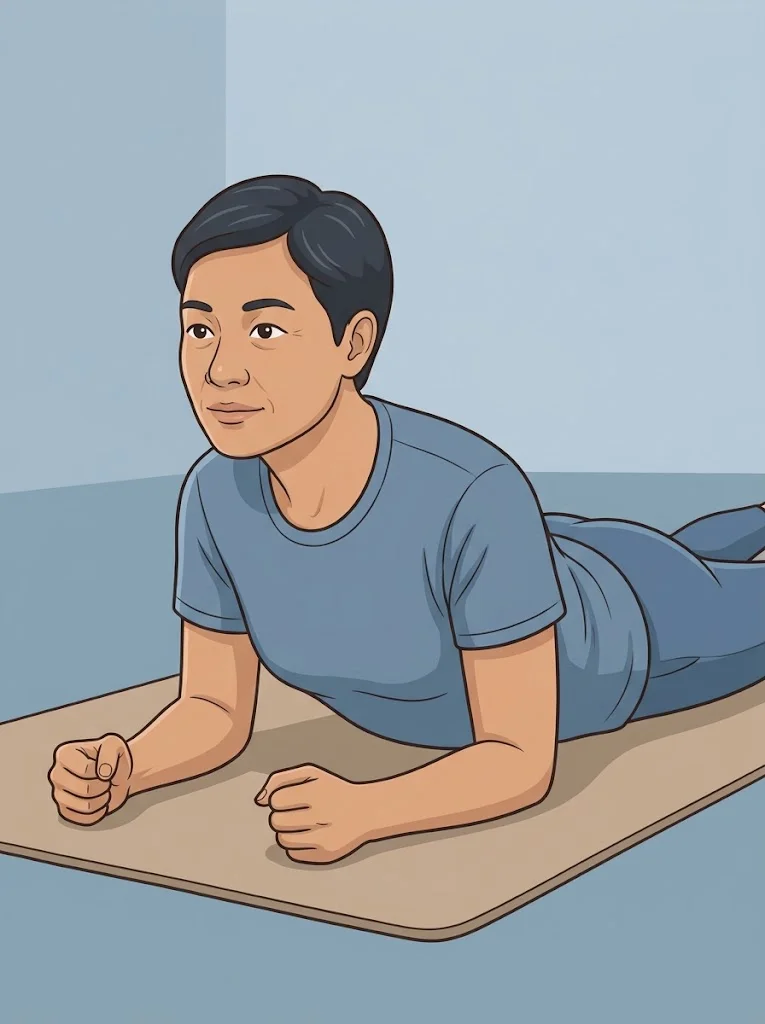
Prone on elbows
start with 5 · hold 10 seconds
Lie face down and prop yourself up on your elbows, placed under your shoulders, keeping the hips on the floor. Hold, then lower.
Watch for — if the leg symptoms retreat towards your back, that is a good sign. If they go further down, stop.
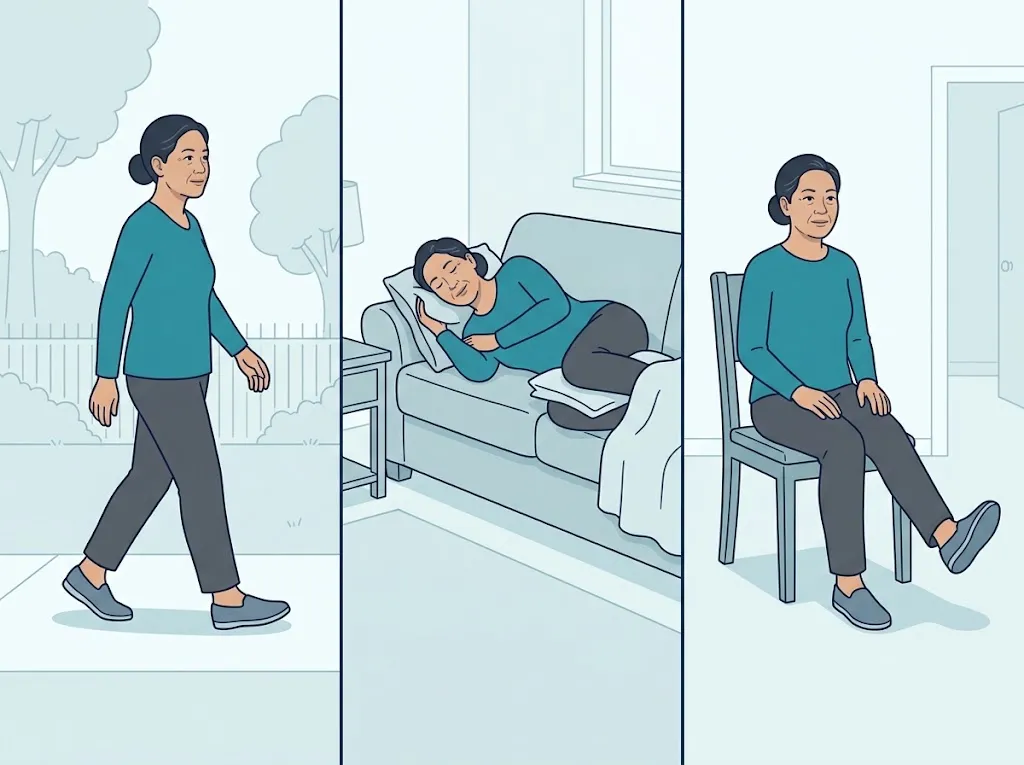
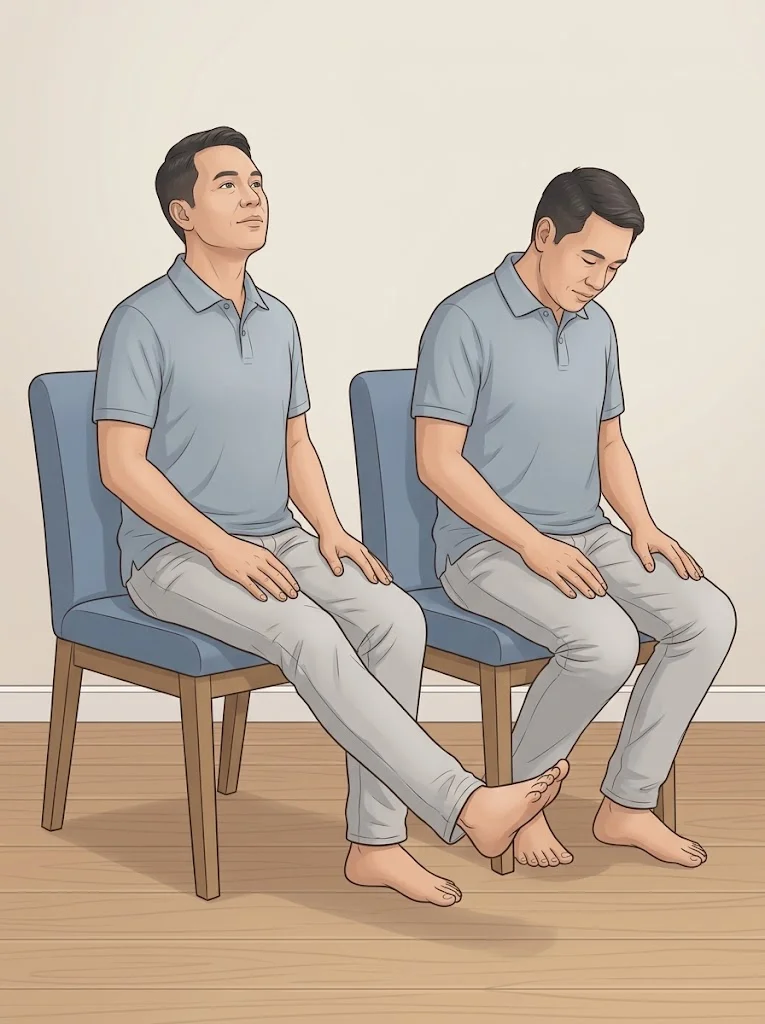
Seated nerve glide
10 each side
Sit on a chair. Slowly straighten the affected leg while tucking your chin down, then bend the knee back while lifting your chin. Move rhythmically and slowly.
Watch for — this should feel like a light pull only. Never take it into sharp pain.
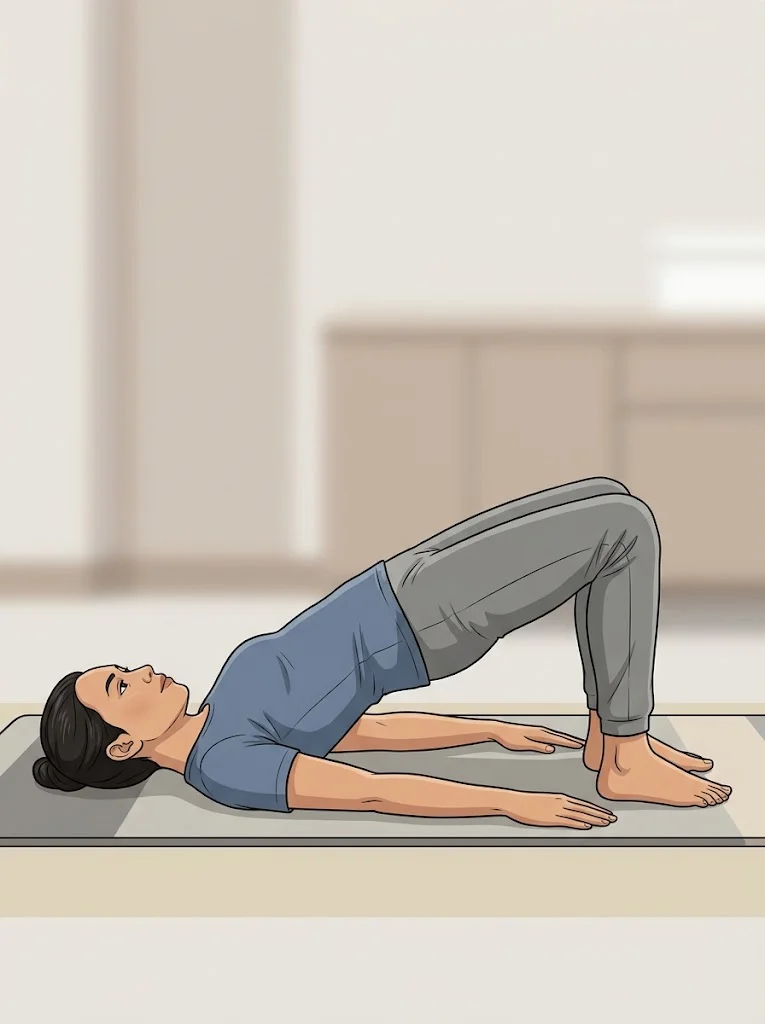
Bridge
2 rounds · 10 times
Lie on your back with knees bent and feet flat. Squeeze your buttocks and lift your hips until your body and thighs are in a straight line. Hold 3 seconds, then lower slowly.
Walking
20–30 minutes a day
Walk as far as you can without the leg symptoms worsening. Split it into shorter spells, then build up.
Prevention and self-care
- Lift by hinging at the hips and bending the knees, not by rounding the back. Keep the load close, and never twist while lifting
- Get up and change position every 30–60 minutes if you sit for long stretches
- Exercise regularly, especially walking and trunk and hip strengthening
- Keep your weight in a healthy range, and do not smoke
- Sleep in whatever position suits you. Many people are more comfortable on their side with a pillow between the knees
Questions to ask your doctor
- Which nerve level is likely affected, and what is causing it?
- Is there any weakness I should be watching for?
- Do I need an MRI now, and would it change the treatment?
- How many weeks before I should expect improvement, and when should I come back?
- Which exercises should I do, and what should I avoid?
Frequently asked questions
Will I need surgery?
Most people do not. A large number improve on their own within six to twelve weeks, even when an MRI shows a disc pressing on the nerve. Surgery is usually considered when the pain is severe and not settling, or when there is clear weakness.
Will the numbness go away?
Numbness and tingling usually improve along with the pain, but they are often the last thing to resolve and can take months. If numbness spreads or weakness increases, go back to your doctor.
Should I rest?
Not in bed for long. Move as much as you comfortably can and return to your usual activities gradually. Long periods of lying still tend to make the whole episode drag on.
Is it always a disc?
No. Other causes include age-related narrowing of the spinal canal, a hip muscle pressing on the nerve, and problems that have nothing to do with the back at all, such as the hip joint or the blood vessels. That is why the examination matters.
References
Related educational reading
These pages explain tests, treatments and rehabilitation that often come up with this condition. They are general reading, not a treatment sequence arranged for you — that has to come from a doctor who has examined you.
Related conditions
Written by Assoc. Prof. Sorawut Thamyongkit, M.D.