
Bone and cartilage: why one heals and the other does not
They sit a few millimetres apart inside the same joint and behave in almost opposite ways. Understanding why explains a great deal about knees, hips and shoulders — including why a broken bone mends and a worn joint surface does not.
Two tissues, one joint
Open any joint and you find both. The ends of the bones are capped with a layer of the smooth white layer covering the ends of bones inside a joint (articular cartilage), often only a few millimetres thick. Underneath it, bone.
They are neighbours, they work as one unit, and almost everything about them is different.
| Bone | Cartilage | |
|---|---|---|
| Feels like | Hard, rigid | Smooth, slightly springy |
| Blood supply | Its own, throughout | None |
| Nerves | Yes | No |
| Cells | Many, in a busy network | Few, spread far apart |
| Rebuilds itself | Continuously, all your life | Very little |
| After an injury | Usually heals | Usually does not |
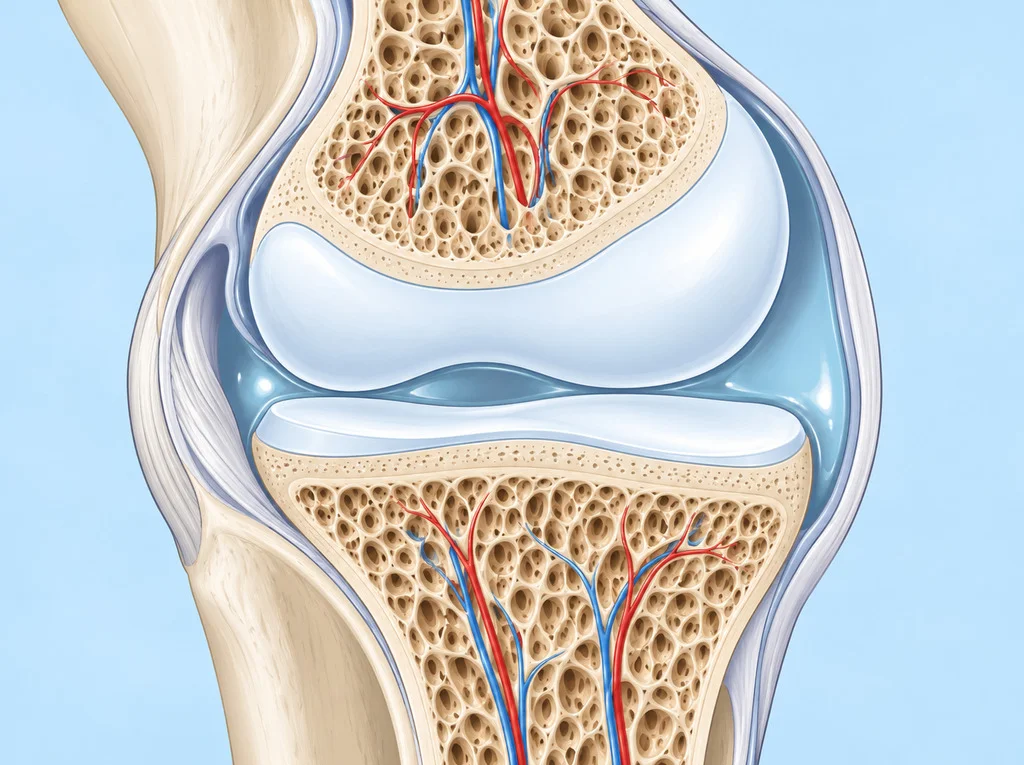
Bone: living, wired, and it heals
Bone has blood vessels running through it and nerves that report pain. It carries cells that remove old bone and cells that build new bone, working continuously — which is covered in bone is an organ, not a scaffold.
That machinery is why a fracture mends. Blood arrives at the break, bringing cells and the materials they need, and over weeks the two ends are joined by new bone. Given reasonable alignment and enough time, the repair can be as strong as the original.
Cartilage: brilliant at its job, and on its own
Cartilage is one of the most impressive materials in the body. It is slipperier than ice on ice, it spreads load across the joint, and it cushions impact — for decades, without maintenance.
It manages this because of what it is made of: a dense, water-holding mesh, with relatively few cells scattered through it. The cells are called chondrocytes, and there are not many of them.
And it has no blood supply. Not a reduced one — none. No vessels, and no nerves either.
That single fact explains most of what follows.
Why the difference matters so much
Healing needs a delivery route. Blood brings the repair cells, the oxygen and the raw material, and carries the debris away. Bone has that route. Cartilage does not.
So when cartilage is damaged, the body cannot mount the same response. Reviews of cartilage repair describe its self-healing capacity as very limited, precisely because it is avascular — without blood vessels — and has few cells to work with. It is why cartilage repair is still a major field of surgical research rather than a solved problem.
There is a second consequence, and it is the one that catches people out: cartilage has no nerves, so early damage does not hurt. Pain in a worn joint comes from the structures around it — the lining, the bone underneath, the capsule — which is why a joint can be some way down the road before it says anything. It is also why “it does not hurt yet” is not evidence that nothing is happening.
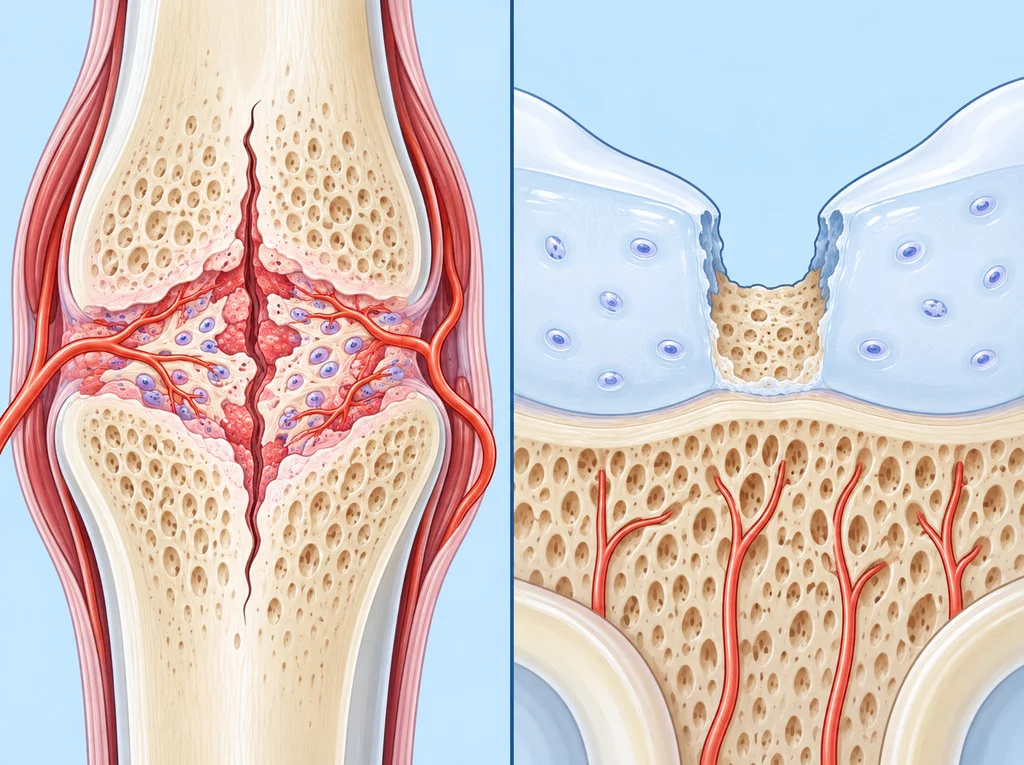
How cartilage is fed, and why movement is the answer
If there is no blood supply, how do the cells survive?
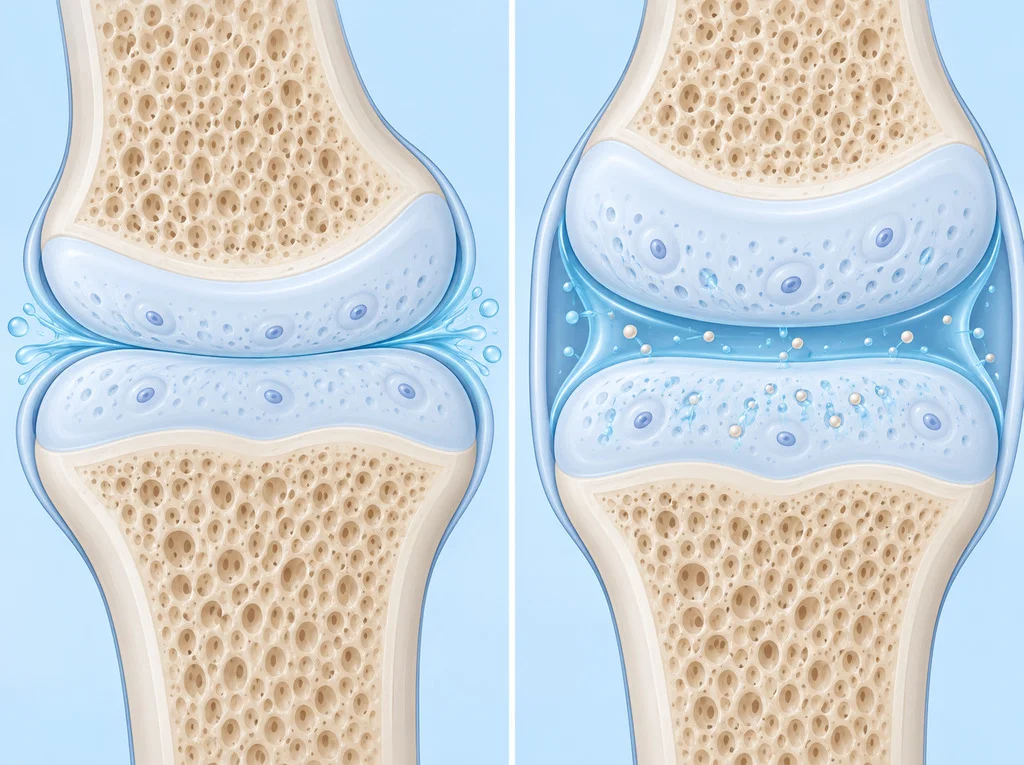
They are fed by synovial fluid, the small amount of slippery fluid inside the joint. Nutrients diffuse in from that fluid, and waste diffuses out. What drives the exchange is load and release: as the joint is compressed and unloaded, fluid moves in and out of the cartilage like water through a sponge being squeezed and let go.
Which means movement is not merely tolerated by cartilage. Movement is how it eats.
A joint that is never moved is a joint whose surface is poorly fed. A joint that is loaded sensibly and often is doing exactly what the tissue is designed for. Work on the mechanics of joint disease makes the same point from the other side: it is abnormal loading — from injury, instability, or carrying much more weight than the joint was built for — that does the damage, while exercise and weight loss generally help.
Looking after both
The two tissues want different things, and happily there is a lot of overlap.
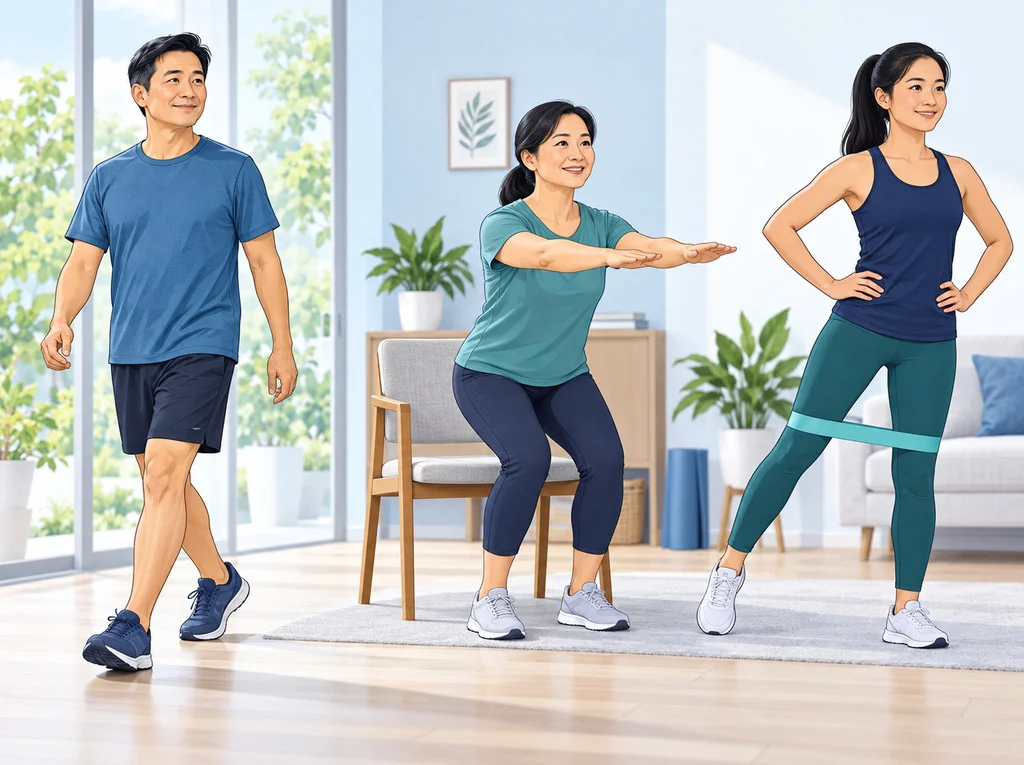
- Move often, at a level you can repeat. Regular ordinary movement feeds cartilage and loads bone. Long unbroken sitting does neither.
- Build the muscle around the joint. Strong muscle absorbs force that would otherwise pass through the surface, and it is the single most reliable thing you can do for a sore knee.
- Increase gradually. Tissue adapts to load applied a little at a time. Most trouble comes from sudden jumps — a new sport, a new distance, a heavy weekend after a quiet year.
- Take weight off the joint if you can. Every step sends several times body weight through the knee, so even a modest reduction is felt at every stride.
- Treat injuries properly, and finish the rehabilitation. A joint left unstable after an injury keeps loading its surface abnormally, which is exactly the pattern linked to later damage.
- Do not wait for pain as your signal. Cartilage cannot produce it. Use what you can do — distance, stairs, getting up from a chair — as the measure instead.
When to see a doctor
Joint noise on its own is usually nothing. Pain, swelling, catching, locking or giving way are worth having looked at, and are covered in knee pain and knee osteoarthritis.
Questions to ask your doctor
- Is my joint pain likely coming from the surface, or from something else?
- Would a scan change what we do, or would it just add a picture?
- What exercise is safe for me, and what should I avoid for now?
- Is there anything about how I move or stand that is adding load?
- How long should I give this before coming back?
Frequently asked questions
Is cartilage just soft bone?
No. They are different tissues with different cells, different building blocks and different jobs. Cartilage is not bone that has not hardened yet — in an adult joint the two are neighbours, not stages.
Can worn cartilage grow back?
Not in the way a broken bone knits back together. Cartilage has no blood supply of its own and few cells, so its natural repair is very limited. That is why so much research goes into repairing it surgically, and why protecting what you have matters.
If cartilage cannot heal, is exercise pointless?
The opposite. Cartilage depends on movement to be fed, and strong muscles change how force passes through the joint. Exercise is standard treatment for joint pain, not something to avoid because of it.
Does a grinding or clicking noise mean my cartilage is damaged?
Noise from a joint is very common and by itself does not tell you much — plenty of painless joints click. It is worth mentioning if it comes with pain, swelling, catching or giving way.
References
- Florencio-Silva R et al. Biology of Bone Tissue: Structure, Function, and Factors That Influence Bone Cells. Biomed Res Int. 2015
- Tee CA et al. Perspective in Achieving Stratified Articular Cartilage Repair Using Zonal Chondrocytes. Tissue Eng Part B Rev. 2023
- Tan AR, Hung CT. Concise Review: Mesenchymal Stem Cells for Functional Cartilage Tissue Engineering. Stem Cells Transl Med. 2017
- Guilak F. Biomechanical factors in osteoarthritis. Best Pract Res Clin Rheumatol. 2011
Related conditions

Written by Assoc. Prof. Sorawut Thamyongkit, M.D.