
Knee osteoarthritis: self-care and exercises
A step-by-step home programme for people with knee osteoarthritis who are managing without surgery: how to adjust daily life, how to walk and cycle, and exactly how to do the exercises, with how many, how often and when to back off.
Who this page is for
This page is for people whose doctor has told them they have knee osteoarthritis and that surgery is not needed at the moment, or who are waiting to see one. It is general information, not a prescription: it cannot see your knee.
Knee osteoarthritis and what it is are explained in the knee osteoarthritis article. The wider picture of how to build a knee programme is in knee rehabilitation. This page is the practical one: what to do, how, and how much.
If you have had a knee operation, follow the plan from your surgeon instead.
What the evidence says
The international guideline from the Osteoarthritis Research Society International lists education about the condition and structured land-based exercise, with weight management for people who are carrying extra weight, as the core treatments for knee osteoarthritis. They come before medicines and before injections.
The Cochrane review of exercise for knee osteoarthritis pooled 139 trials. Exercise probably improves pain, everyday function and quality of life in the short term. The reviewers were also honest about the limits: the size of the benefit may be too small for some people to notice, many trials could not hide from the participants which treatment they were getting, and nobody found that one kind of exercise beats another.
In plain terms: exercise helps, it will not cure the joint, and the exercise that works best is the one you keep doing.
Looking after the knee through the day
Exercise is only part of it. Small changes through the day add up.
- Keep moving, in smaller pieces. Sitting for a long time stiffens the knee. Stand up and walk around for a minute every 30 to 45 minutes.
- Share the load. Use the stairs less when you can, avoid long spells of squatting, kneeling or sitting on the floor, and use a chair of a normal height or higher.
- Use a stick if walking hurts. Hold it in the hand opposite the sore knee. It takes weight off the joint.
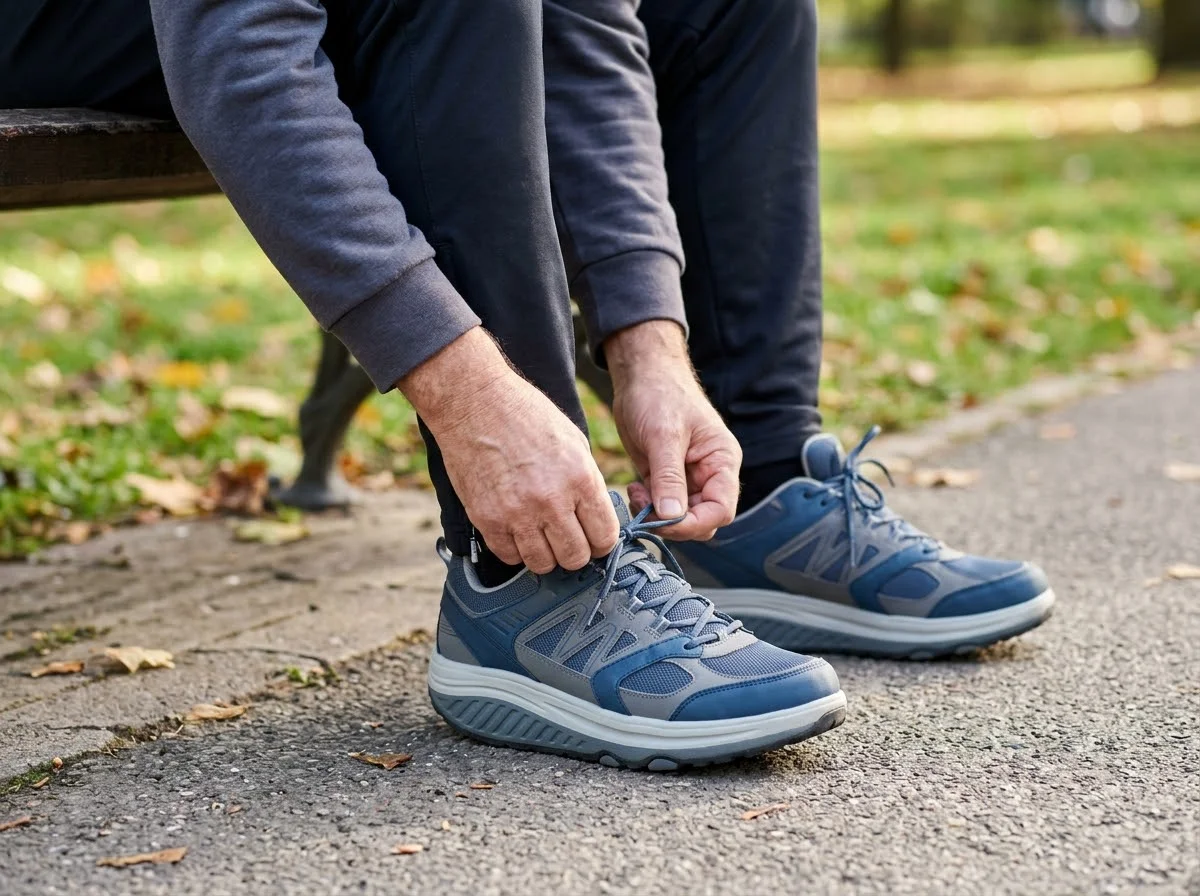
- Choose shoes that cushion and fit well.
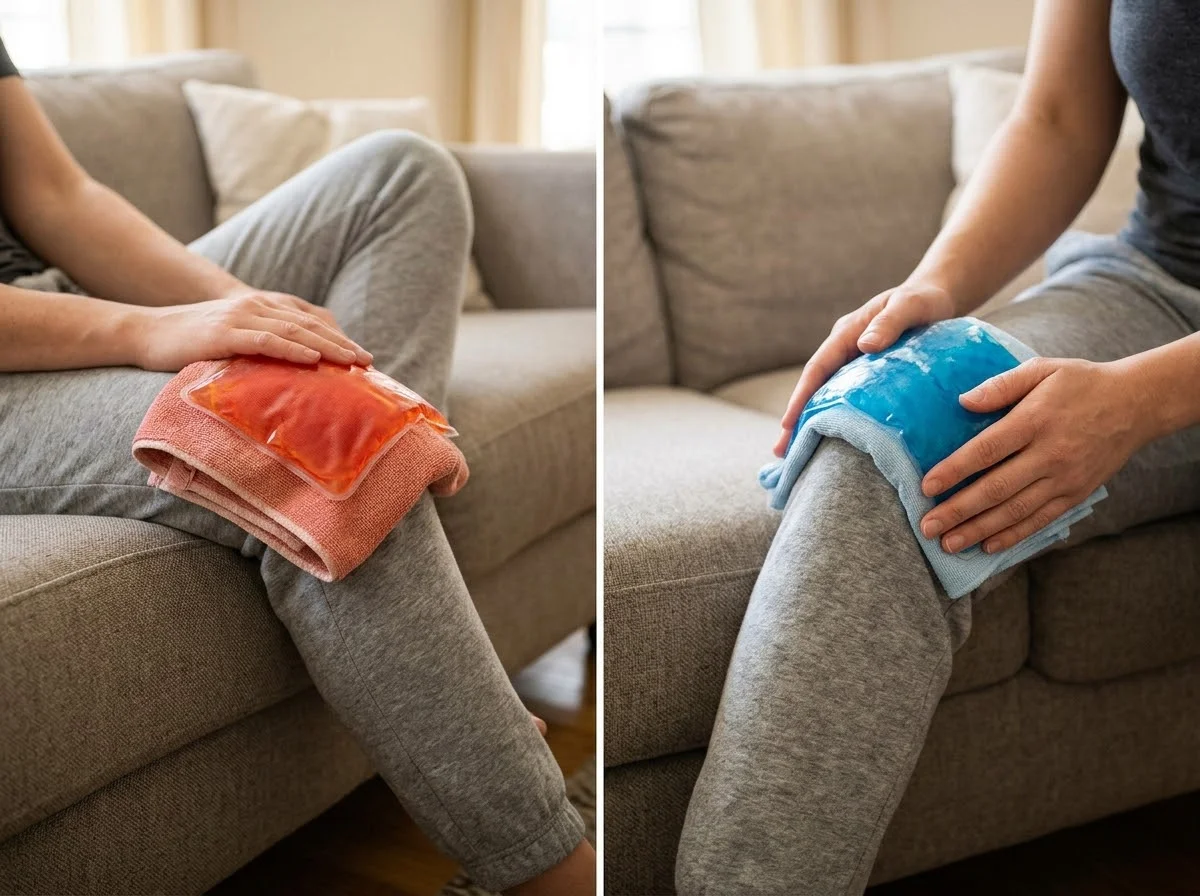
- Heat or cold are both fine for comfort. Use whichever feels better for 10 to 15 minutes, with a cloth between the skin and the pack. Warmth before the exercises and a cold pack afterwards suits many people.
- Look after your weight. If you are carrying extra weight, even a modest loss lightens the load on the knee with every step. Ask your doctor or a dietitian for a plan you can keep up.
- Medicines. Some people use pain-relief medicine so that they can exercise. The classes and their cautions are in pain medicines: ask a doctor or pharmacist what is suitable for you.


Before you start
- Warm up. Walk gently for five minutes or cycle without resistance. Bend and straighten the knee a few times.
- Choose a firm surface and a sturdy chair that will not slide. A soft bed is too springy for the lying exercises; use a mat on the floor, or a firm bed.
- Wear shoes for the standing exercises.
- Breathe normally. Do not hold your breath while holding a position.
- Count the slow parts aloud if it helps: “one-thousand-one, two…”.
How hard should it feel?
Muscles should feel they are working. Beyond that, use this as a guide:
| What you feel | What it means | What to do |
|---|---|---|
| Muscle tiredness or a mild ache in the knee, about 4 out of 10 or less | Expected | Carry on |
| An ache in the knee higher than that, which settles within 24 hours | The amount was a little much | Next time, do fewer repeats or a smaller movement |
| Sharp pain, a catch, the knee giving way, new swelling, or pain that is worse the next morning | Too much, or something else is going on | Stop that exercise. Rest the knee for a day or two, then restart at half the amount. If it happens again, speak to a doctor or physiotherapist |
The “4 out of 10” is a rule of thumb used by many physiotherapists, where 0 is no pain and 10 is the worst pain you can imagine. It is a guide, not a measurement from the studies above.
The programme
Strengthening: three non-consecutive days a week (for example Monday, Wednesday, Friday). The exercises are in three groups: lying down (1 to 6), standing (7 to 9) and stretches (10 and 11). A full session takes about 30 to 40 minutes.
Start where you are. In the first two weeks, do one round of exercises 1 to 6, then the two stretches. From week three, if the knee has coped well, add the standing exercises 7 to 9 and do two rounds. Each exercise is shown with the numbers to aim for: if you cannot reach them yet, do what you can with good form and add one or two repeats each week. Quality first.
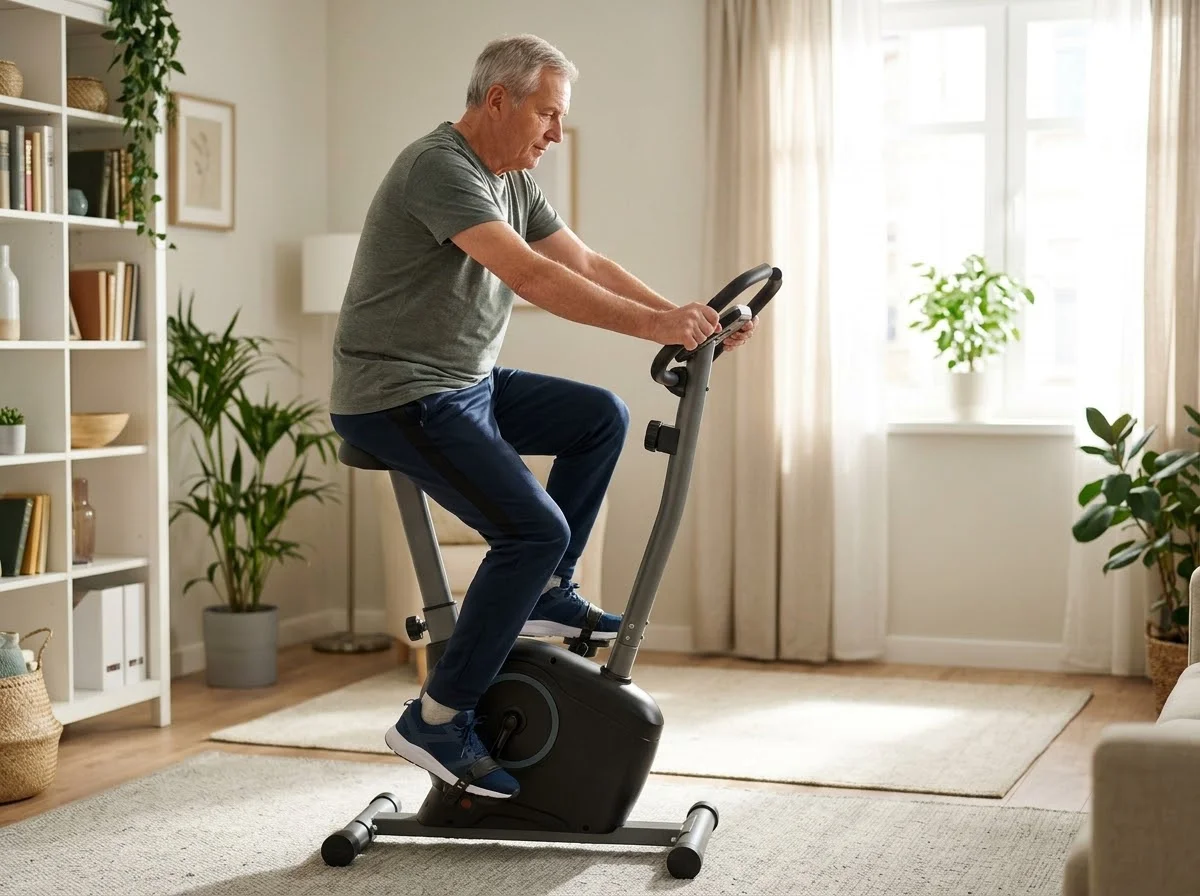
Walking or cycling: begin with 10 minutes, on a flat surface, on most days. Add about five minutes a week until you reach 30 minutes, which you can split into two or three shorter spells. Cycling on a stationary bike with the seat set so the knee is slightly bent at the bottom of the pedal is a good alternative when walking is sore.

Do the exercises on both legs. Where a card says “the sore leg”, start with that side and then do the other.
Lying down
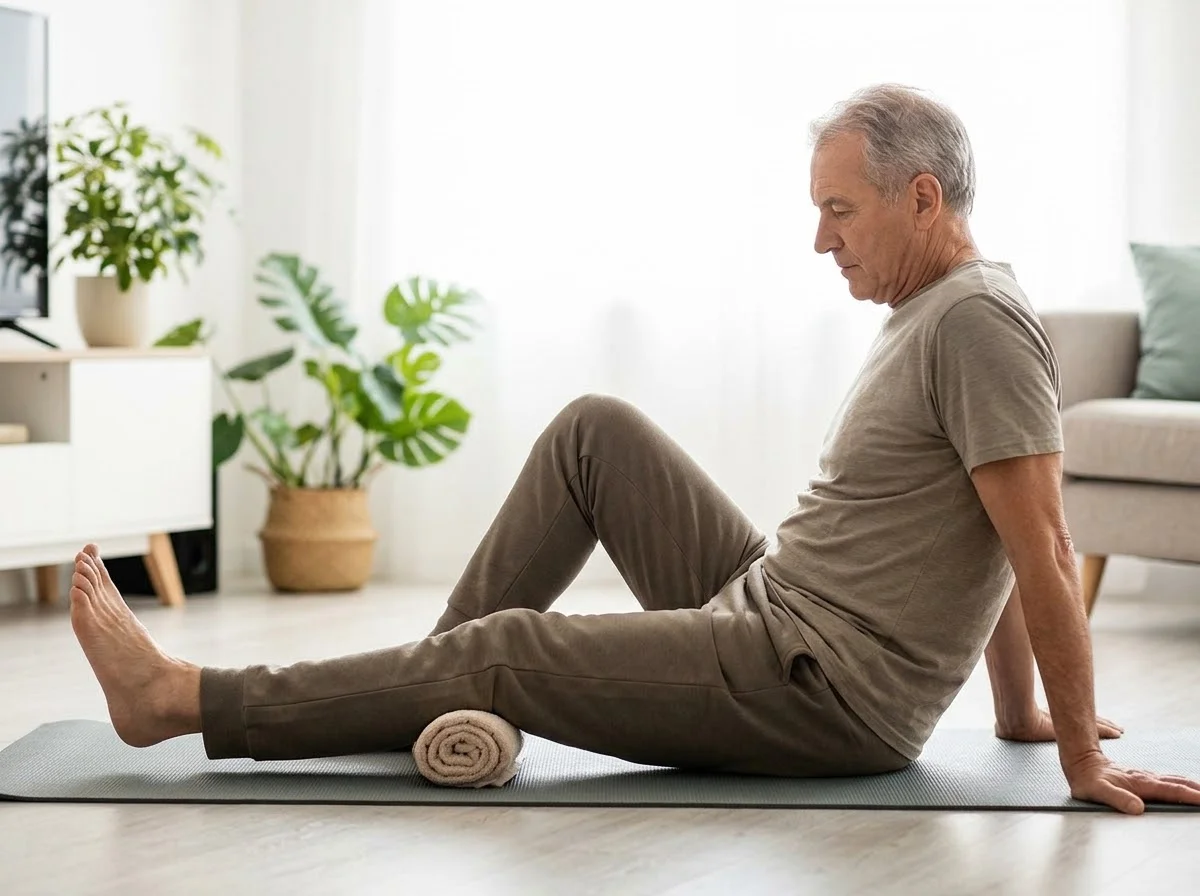
1. Thigh tightening (quadriceps setting)
1–2 rounds · 10 times · hold 5 seconds
Start: sit on the floor or a firm bed and lean back on your hands. Bend the other knee with that foot flat. Straighten the sore leg and rest the back of the knee over a rolled towel. You can also do this lying on your back.
Do: press the back of the knee down into the towel and tighten the muscle on the front of the thigh, so that the kneecap slides up slightly. Count to 5. Relax for 3 seconds.
Feel: the front of the thigh working. No pain in the knee itself.
Watch for — hold your breath and you will tense the whole body. Keep breathing. This is the gentlest exercise and the one to start on a day when the knee is sore.
2. Heel slide
1–2 rounds · 10 times · hold 3 seconds
Start: lie on your back with both legs straight, on a firm surface with socks on or a smooth cloth under the heel.
Do: slowly slide the heel of the sore leg towards your bottom, bending the knee as far as is comfortable. Count to 3 and hold. Slide the heel back out until the leg is straight again, taking 3 seconds.
Feel: a gentle stretch at the front of the knee. Stop at a stretch, not at a sting.
Watch for — keep the kneecap pointing at the ceiling. If the knee will not bend or straighten as far as it did before, do not force it.
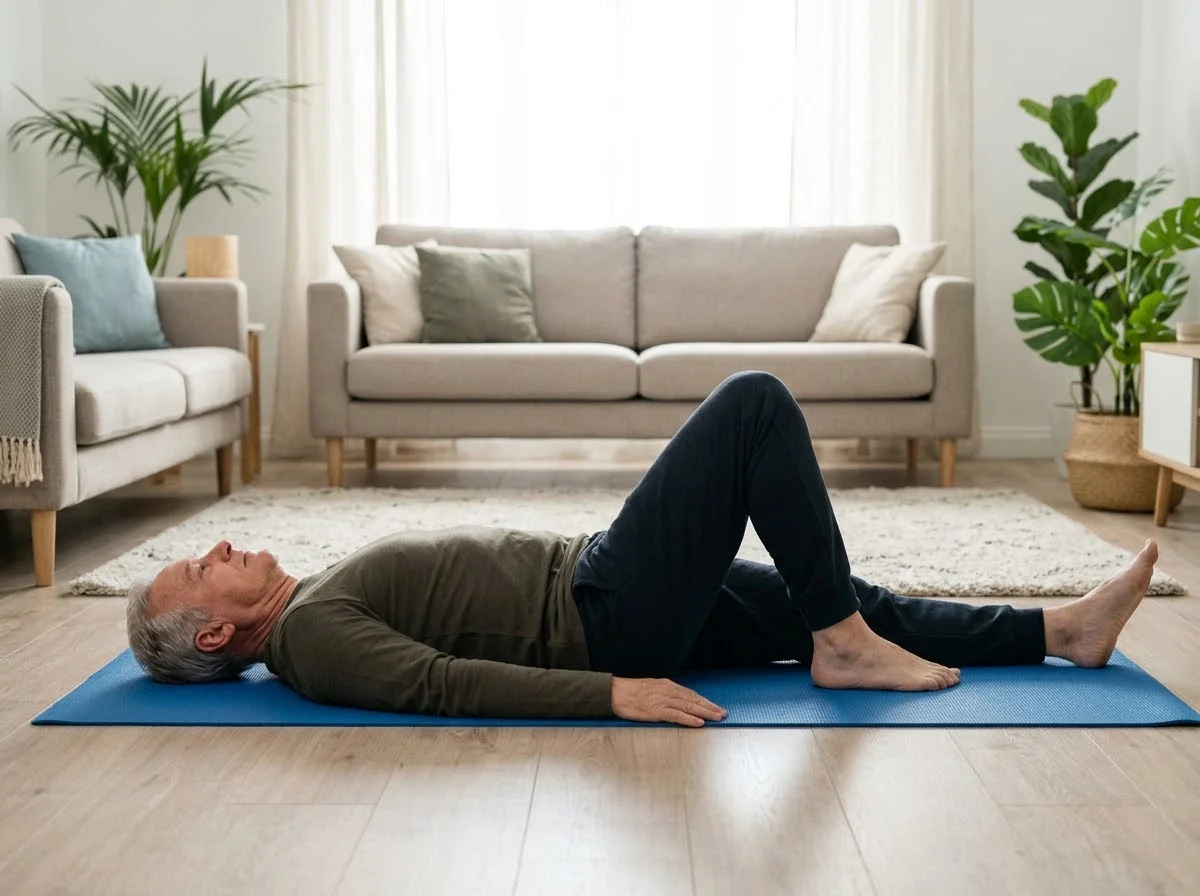
3. Straight leg raise
1–2 rounds · 10 times · hold 3 seconds
Start: lie on your back. Bend the other knee with that foot flat on the floor. Keep the sore leg straight, with the toes pointing up.
Do: tighten the thigh as in exercise 1 first. Keeping the knee straight, lift the leg until the heel is level with the other knee, about 20 to 30 centimetres off the floor. Hold for 3 seconds, then lower slowly over 3 seconds.
Feel: the front of the thigh and the top of the hip working.
Watch for — the knee must stay straight the whole way. If it bends, the thigh is not tight enough: lift less high. Do not arch the lower back off the floor.
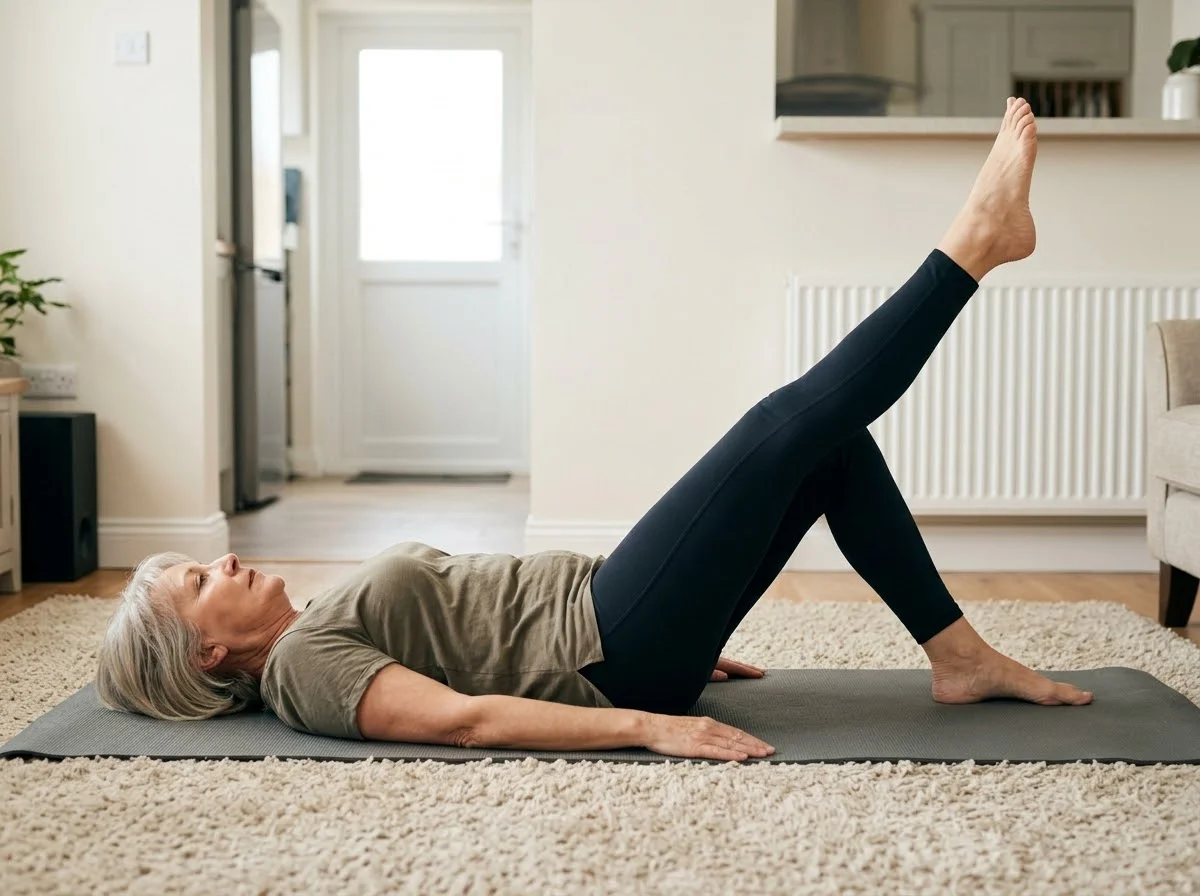
4. Pillow squeeze (inner thigh)
1–2 rounds · 10 times · hold 5 seconds
Start: lie on your back with both knees bent and both feet flat on the floor. Put a folded pillow or a soft ball between your knees.
Do: squeeze the pillow with your knees. Count to 5. Relax slowly.
Feel: the muscles on the inside of the thighs working.
Watch for — squeeze firmly but not with all your strength. Keep breathing, and keep your back relaxed on the floor.
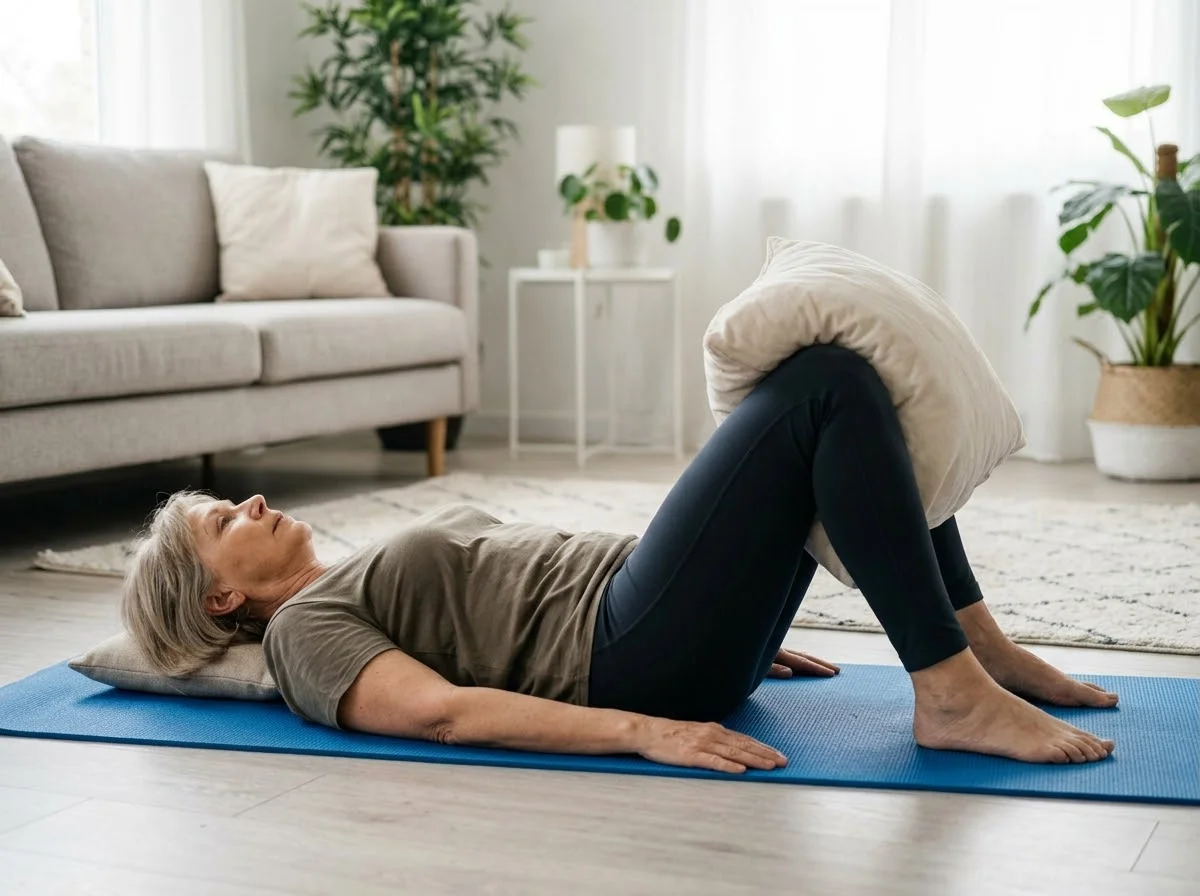
5. Side-lying leg raise (hip)
1–2 rounds · 10 times each side
Start: lie on your side. Bend the bottom leg for balance. Keep the top leg straight, in line with your body, and your hips stacked one above the other.
Do: with the toes pointing forward, lift the top leg slowly about 30 centimetres, or until you feel the muscles at the side of the hip working. Hold for 2 seconds. Lower slowly.
Feel: the outside of the hip and buttock.
Watch for — do not roll your body backward to get the leg up. If the leg drifts forward or the toes point up, bring it back in line. Hip strength helps keep the knee from collapsing inward when you walk.
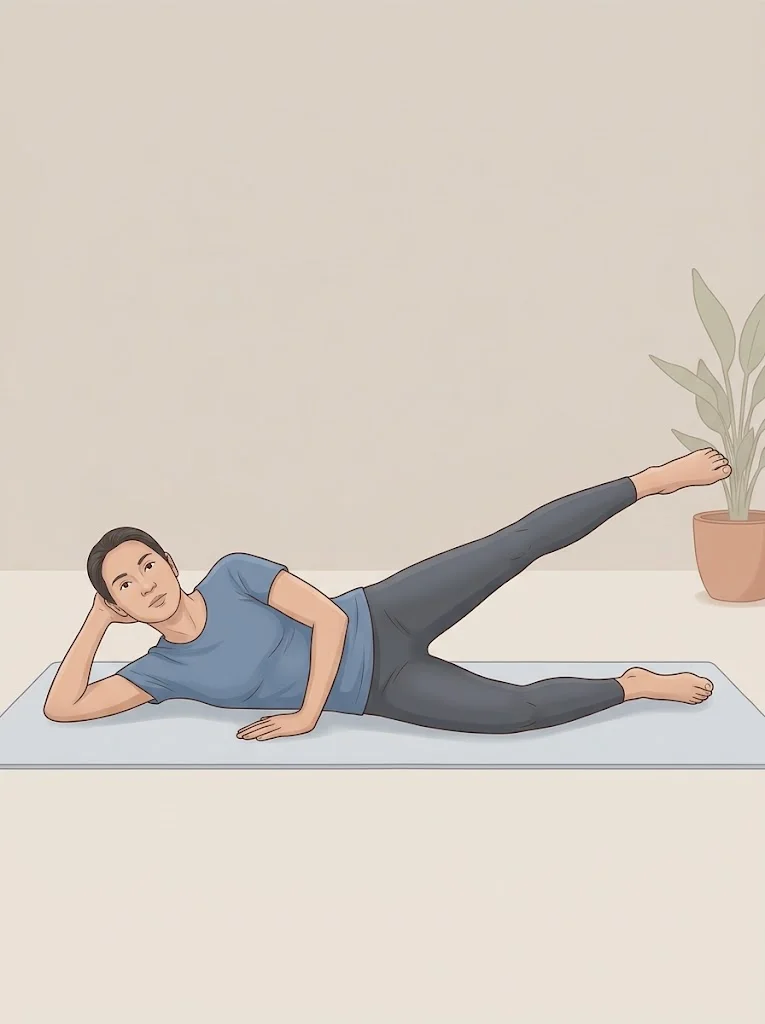
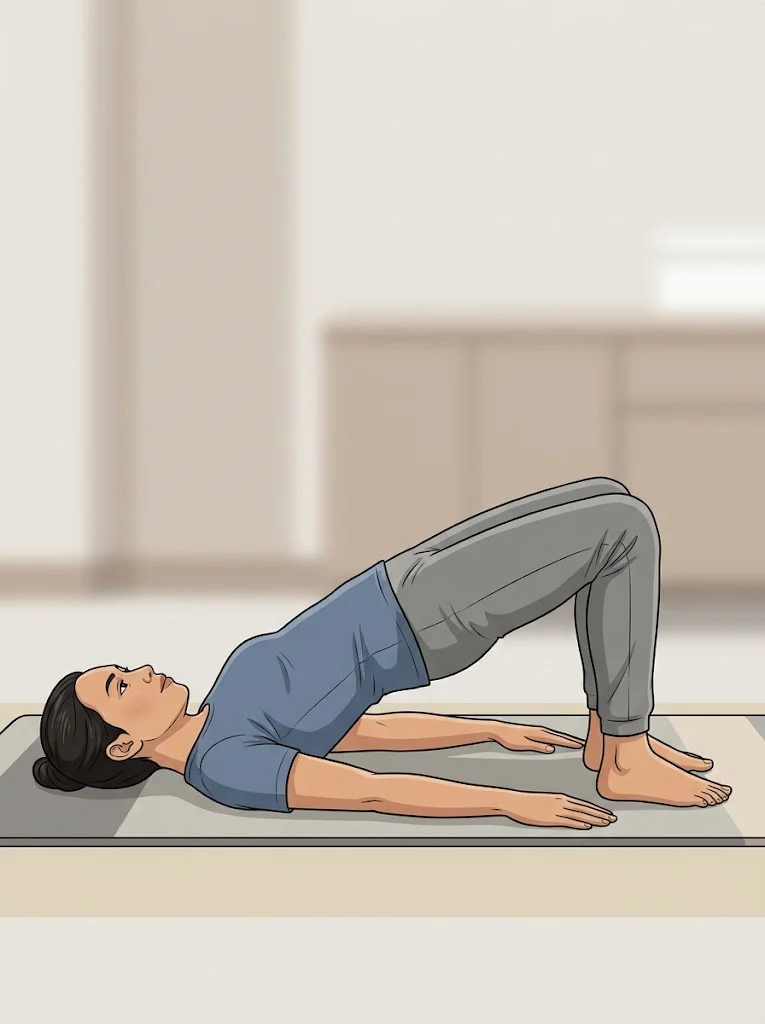
6. Bridge
1–2 rounds · 10 times · hold 3 seconds
Start: lie on your back with both knees bent and both feet flat on the floor, hip-width apart. Place the heels about a foot-length from your bottom. Arms by your sides.
Do: squeeze the buttocks and lift the hips until your body makes a straight line from shoulders to knees. Hold for 3 seconds. Lower slowly, one bone at a time.
Feel: the buttocks and the back of the thighs.
Watch for — do not arch the lower back to lift higher. If the front of the knee hurts, bring the feet a little closer to your bottom and lift less high.
Standing
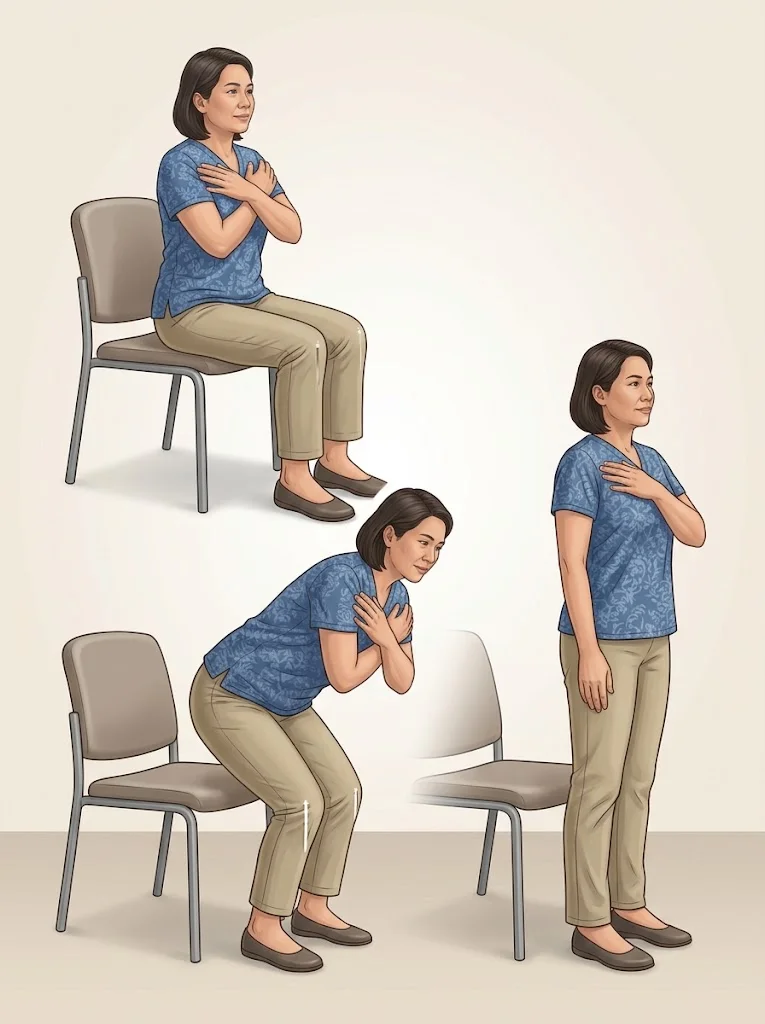
7. Sit to stand
1–2 rounds · 8–10 times
Start: sit near the front of a sturdy chair, with your back straight and feet flat, about hip-width apart, and slightly behind the knees. Put a cushion on the seat to make it higher if this is too hard. Cross your arms over your chest.
Do: lean forward from the hips, then stand up fully, straightening the knees and hips. Pause for a second. Then sit back down slowly over about 3 seconds, without dropping into the chair.
Feel: the front and back of the thighs and the buttocks working.
Watch for — the knees stay in line with the middle of the feet, and do not fall inward. If you cannot stand up without help, rest your hands lightly on your thighs, or on the arms of the chair, and use them as little as you can.
8. Chair squat
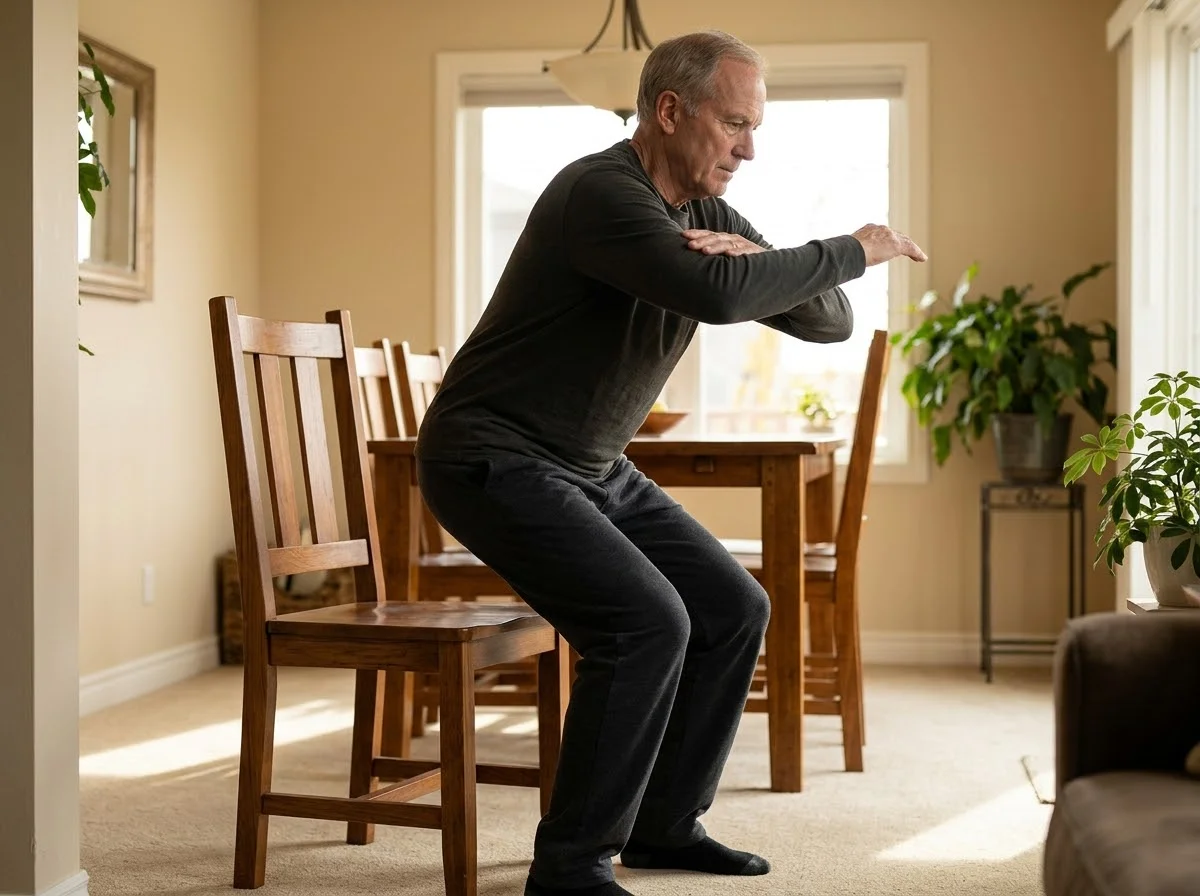
1–2 rounds · 8–10 times
Start: stand in front of a sturdy chair, as if about to sit, with your feet hip-width apart. Fold your arms in front of you at shoulder height.
Do: push your hips back and bend your knees, lowering slowly over about 3 seconds until your bottom just touches the seat. Do not sit down. Stand straight back up.
Feel: the thighs and buttocks working harder than in sit to stand, because you never rest on the chair.
Watch for — the knees stay in line with the middle of the feet and do not fall inward. Only go as low as is comfortable: a higher chair, or a cushion on the seat, makes it easier.
9. Standing side leg raise (hip)
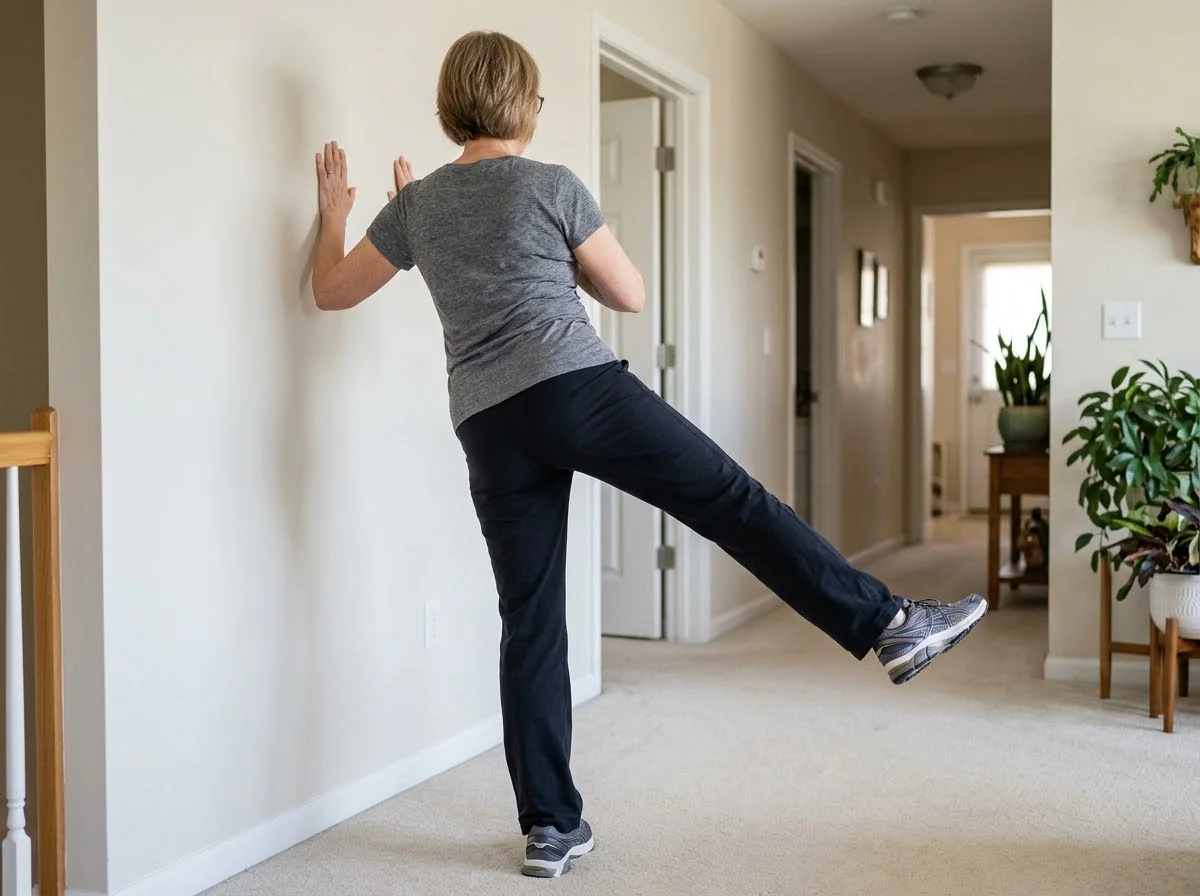
1–2 rounds · 10 times each side · hold 2 seconds
Start: stand facing a wall or a sturdy worktop, with both hands resting on it for balance and your feet together.
Do: keeping your body upright and your toes pointing forward, lift one straight leg out to the side, about 30 centimetres or as far as is comfortable. Hold for 2 seconds. Lower slowly. Do all the repeats on one side, then change legs.
Feel: the outside of the hip of the leg that lifts, and the hip of the leg you are standing on.
Watch for — do not lean your body sideways to lift the leg higher. Keep the standing knee straight but not locked.
Stretches
Finish each session with these two. Stretch to a steady pull, never to pain.
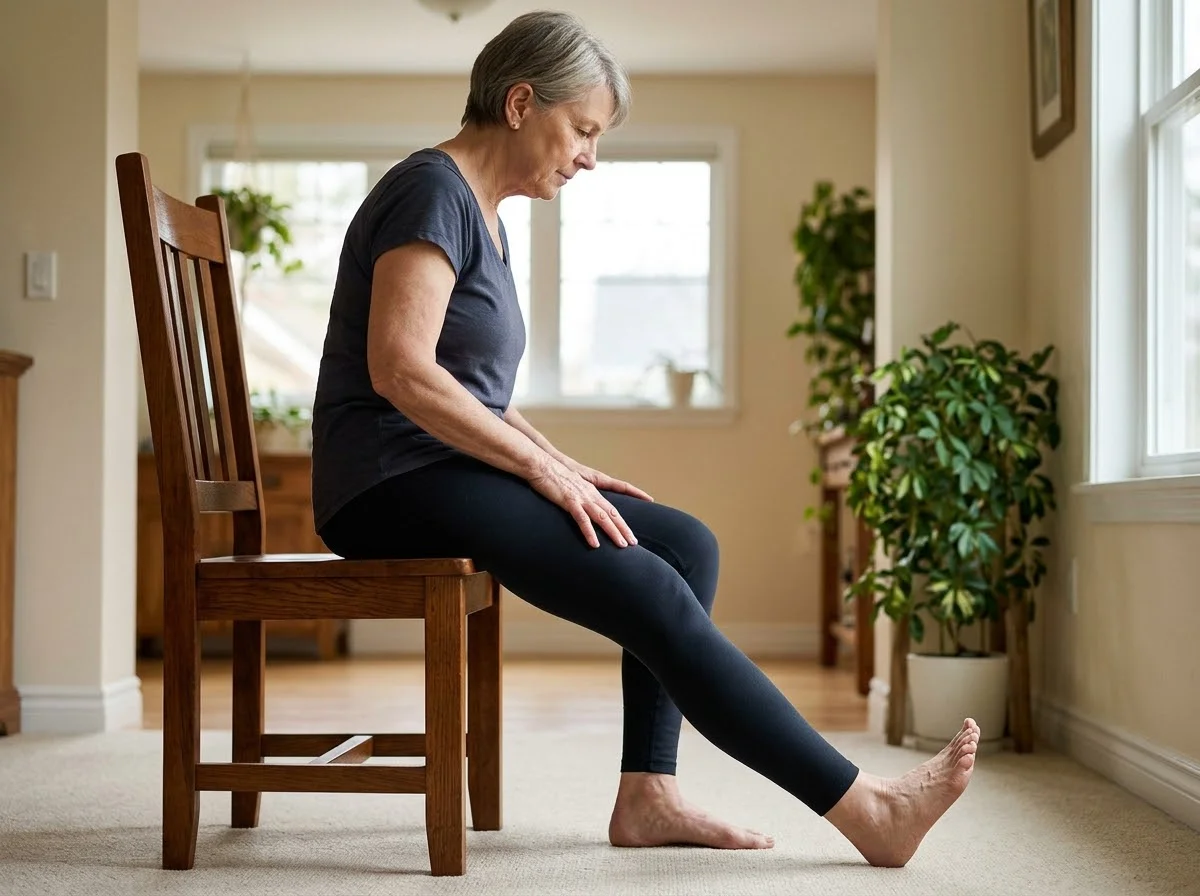
10. Seated hamstring stretch
2 rounds each leg · 1 stretch each round · hold 20–30 seconds
Start: sit near the front of a sturdy chair. Stretch the leg you are stretching out in front of you, with the heel on the floor and the toes pointing up. Keep the other foot flat on the floor.
Do: keep your back straight and lean forward slowly from the hips until you feel a pull behind the thigh of the straight leg. Hold for 20 to 30 seconds. Sit back up and change legs.
Feel: a steady pull behind the thigh, not pain behind the knee.
Watch for — lean from the hips rather than rounding your back, and do not bounce.
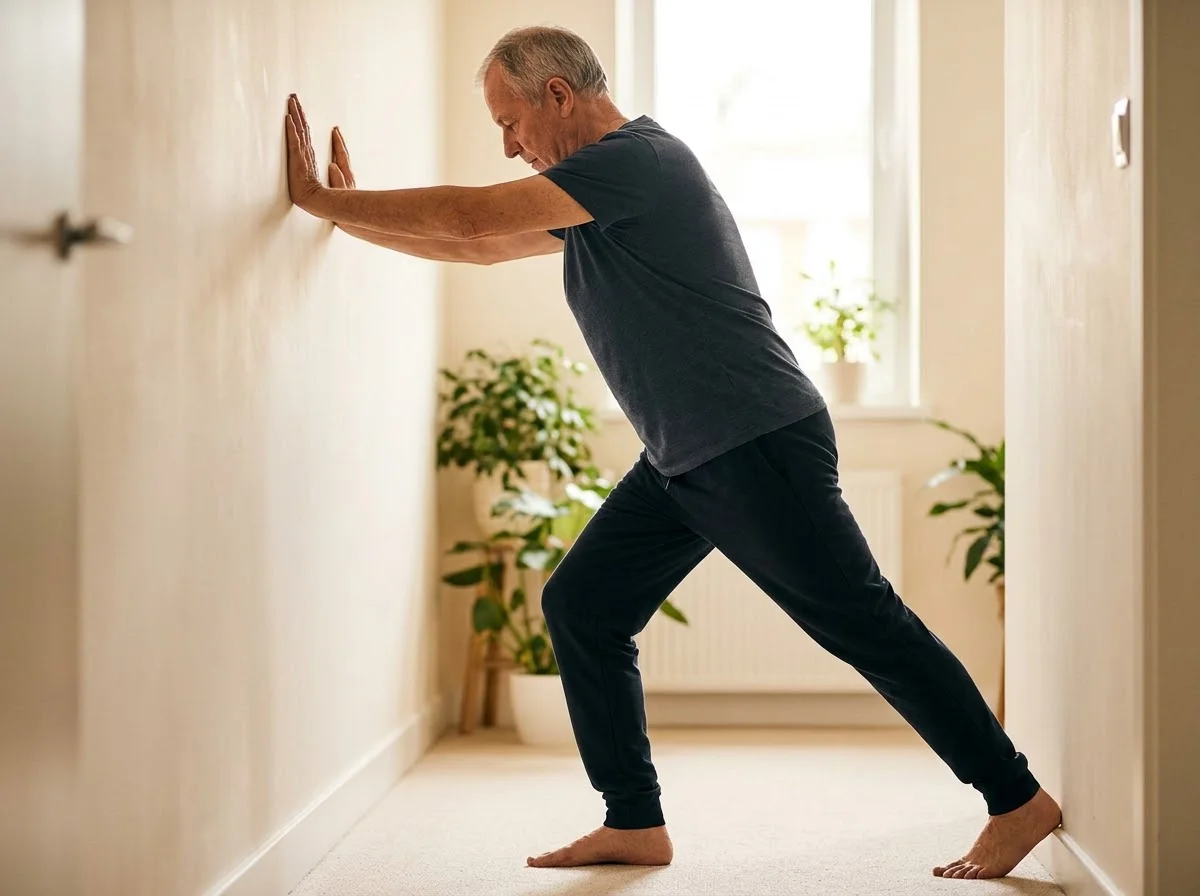
11. Calf stretch at the wall
2 rounds each leg · 1 stretch each round · hold 20–30 seconds
Start: stand facing a wall, about an arm’s length away, with both hands flat on the wall at shoulder height. Step the leg you are stretching back about one stride, with the heel down and the toes pointing at the wall.
Do: keep the back leg straight and bend the front knee, leaning towards the wall until you feel a pull in the calf of the back leg. Hold for 20 to 30 seconds. Come back up and change legs.
Feel: a steady pull in the calf, not pain in the knee.
Watch for — the back heel stays on the floor. Stop if the knee hurts, and do not bounce.
Making it harder, and when to stay put
When a round feels easy on three sessions in a row and the knee is not worse the next day, make one change at a time:
- More repeats, up to about 15.
- Slower lowering, counting 5 seconds on the way down.
- Light weight: a 1 kg bag of rice (or a small water bottle) tied at the ankle for exercises 3, 5 and 9, or held against the chest for exercises 7 and 8. Ask your physiotherapist before going heavier.
If you have a flare, with the knee more swollen and sore than usual, go back to exercises 1 and 2 only, plus gentle walking, until it settles. A flare does not mean the programme has failed.
When to see a doctor
Seeing a doctor or physiotherapist at the start is worthwhile even if your pain has been present a long time: they can check that your knee really is the problem and tailor the programme.
Questions to ask your doctor or physiotherapist
- Is a home programme like this suitable for my knee, and which exercises should I change or leave out?
- How many days a week, and how many repeats, should I aim for?
- Can you watch me do the exercises once, to check my form?
- Is walking, cycling or swimming best for me while the knee is sore?
- What would tell you that non-surgical care is no longer enough?
Frequently asked questions
Will exercise wear my knee out faster?
The evidence points the other way. Exercise is recommended by every major international guideline for knee osteoarthritis, and the muscles that exercise builds take load that the joint would otherwise carry. Doing it in the amounts described here is not a risk to the joint itself.
Is it normal for the knee to hurt while I exercise?
A mild to moderate ache while you exercise is common and is not a sign that you are doing harm, as long as it settles within a day. Sharp pain, a knee that swells, or pain that is clearly worse the next morning means the amount was too much: do less next time.
Which is better, walking, cycling or swimming?
The Cochrane review found no difference between types of exercise. The best one is the one you will do regularly. Cycling and swimming load the knee less during a painful spell; walking is simple and free. Strengthening work is worth adding to whichever you choose.
How long until I notice a difference?
The benefit builds over weeks of regular work rather than days. It is modest on average and varies from person to person, and it is only kept up while the exercises are kept up.
Do I still need to see a doctor if I am doing well with exercise?
Yes. A doctor or physiotherapist can check that the pain really does come from the knee, that the exercises suit you, and that nothing else needs treating. Exercise is part of care, not a replacement for being examined.
References
Related conditions
Written by Assoc. Prof. Sorawut Thamyongkit, M.D.