
Pain medicines — the classes and what to know
Painkillers come in several classes that work differently and carry different cautions. This page is an overview so you can talk to a doctor or pharmacist — not so you can choose for yourself.
What medicine is for
In most bone and joint problems medicine is not the main treatment — it is what makes the main treatment possible. If you hurt too much to move, you cannot do the rehabilitation. Medicine opens a window in which you can.
That changes how it should be used. The aim is not “no pain at all” but “little enough pain to do what needs doing”.

The classes used most
Paracetamol-type painkillers
Widely used, and easy on the stomach. The main caution is the liver, particularly for anyone who drinks regularly or has liver disease. Watch for doubling up, too: many cold and combination painkillers contain the same drug.
Non-steroidal anti-inflammatory drugs (NSAIDs)
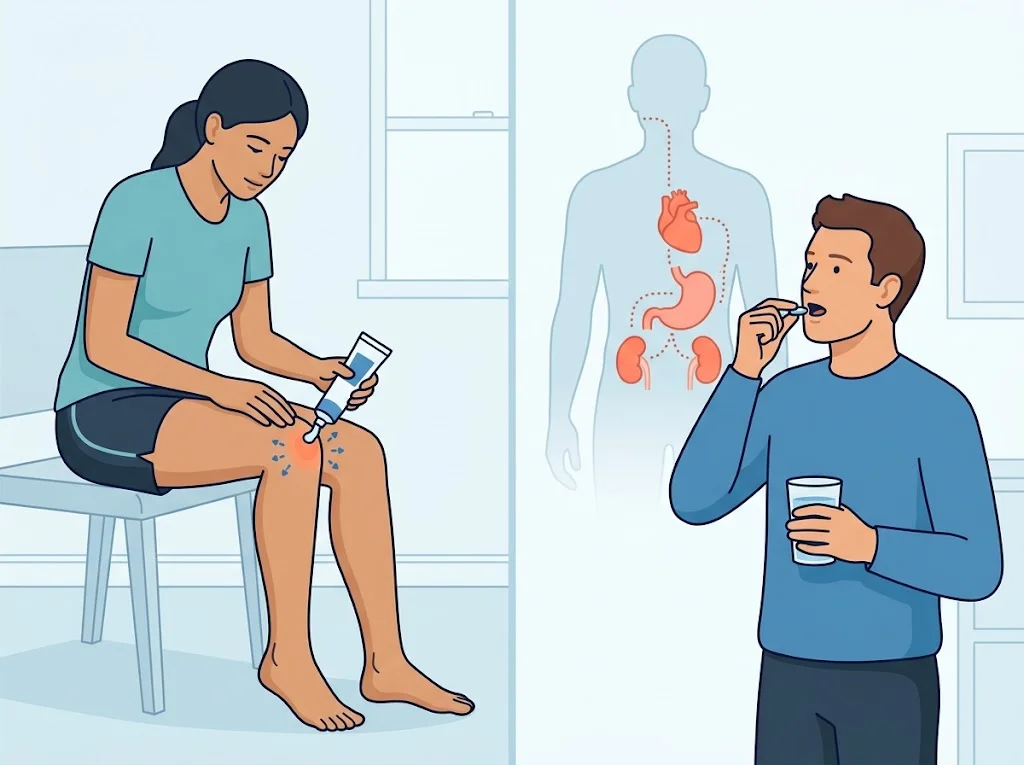
These reduce inflammation as well as pain, so they often suit problems where inflammation is part of the picture. The cautions are the stomach, kidneys, blood pressure and heart. Risk is higher in older people, in kidney or heart disease, in anyone who has had a stomach ulcer, and in anyone taking blood thinners.
anti-inflammatory drugs that are not steroids — the ibuprofen and diclofenac families, among others also come as gels and patches, which are a good option for joints near the surface such as the knee, hand and elbow, because far less of the drug reaches the bloodstream.
Muscle relaxants
Used in some cases where muscle spasm is part of the problem. They commonly cause drowsiness, so take care with driving and machinery, and they are generally for short-term use.
Medicines that act on nerve signals
For pain coming from a nerve — radiating leg pain, or numb fingers — a doctor may consider a drug that works on nerve signalling instead. These are titrated slowly and have their own side effects.
Opioids
Current guidelines sharply limit these for long-term musculoskeletal pain: the long-term benefit is limited and there is a real risk of dependence. If they are prescribed, there should be a clear plan for how long and how they will be stopped.

Injected is not simply “stronger”
Some people assume an injection is a stronger version of a tablet. It is a different thing. A Cochrane review comparing injected non-steroidal anti-inflammatory drugs with injected corticosteroid for trigger finger found that at 12 to 24 weeks the resolution rates were not clearly different, while more people in the NSAID group still had moderate to severe symptoms — on low-certainty evidence.
Injections have their own page: injections into and around a joint.
When to see a doctor
Questions to ask your doctor or pharmacist
- Which class is this, and how long should I take it?
- Does it interact with anything else I take, including supplements?
- Given my other conditions, is there a class I should avoid?
- What side effect means stop and come back straight away?
- If this does not work, what is next?
Frequently asked questions
Why does this page not give doses?
Because the right dose depends on weight, age, liver and kidney function, other conditions and everything else you take. This site cannot see any of that. Doses have to come from a doctor or pharmacist who knows your history.
Do topical gels actually work?
Topical anti-inflammatories are recommended in several guidelines for joints close to the surface, such as the knee and hand. Much less of the drug reaches the bloodstream than with tablets, so the effects on the stomach and kidneys are smaller.
The pain has gone. Does that mean it is healed?
No. Medicine reduces pain without fixing the cause. The point of it is to let you move and rehabilitate — not to mask symptoms while you load the joint as hard as before.
References
- Lin I et al. What does best practice care for musculoskeletal pain look like? Eleven consistent recommendations from high-quality clinical practice guidelines: systematic review. Br J Sports Med. 2019
- Leow MQH et al. Non-steroidal anti-inflammatory drugs (NSAIDs) for trigger finger. Cochrane Database Syst Rev. 2021
Related conditions
Written by Assoc. Prof. Sorawut Thamyongkit, M.D.