
Bone is an organ, not a scaffold
Most people picture the skeleton as dry timber holding the body up. It is living tissue that rebuilds itself, stores the body’s calcium, makes blood, and sends chemical messages to other organs.
The picture most people have
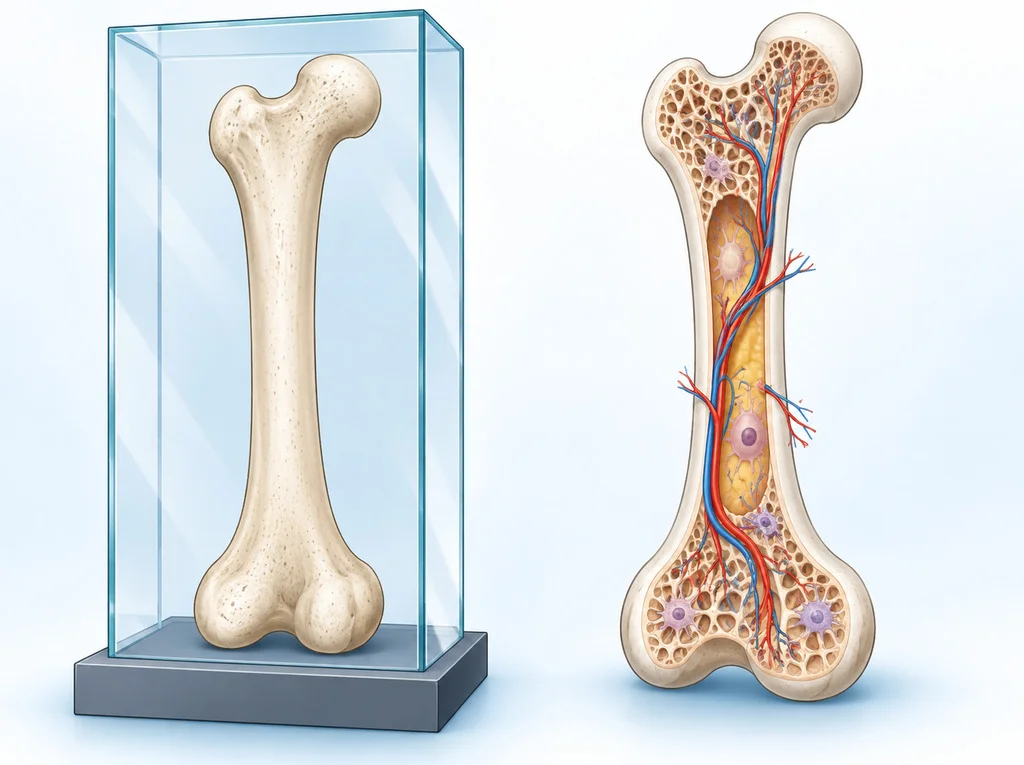
Ask someone to imagine a bone and they usually picture the dry, pale thing in a museum case: hard, still, finished. Something like the timber inside a wall — structural, and otherwise inert.
That picture is understandable, and it is wrong in an important way. The bone in a display case is what is left after everything alive has gone. In your body, bone is one of the busiest tissues you have.
It is being rebuilt as you read this
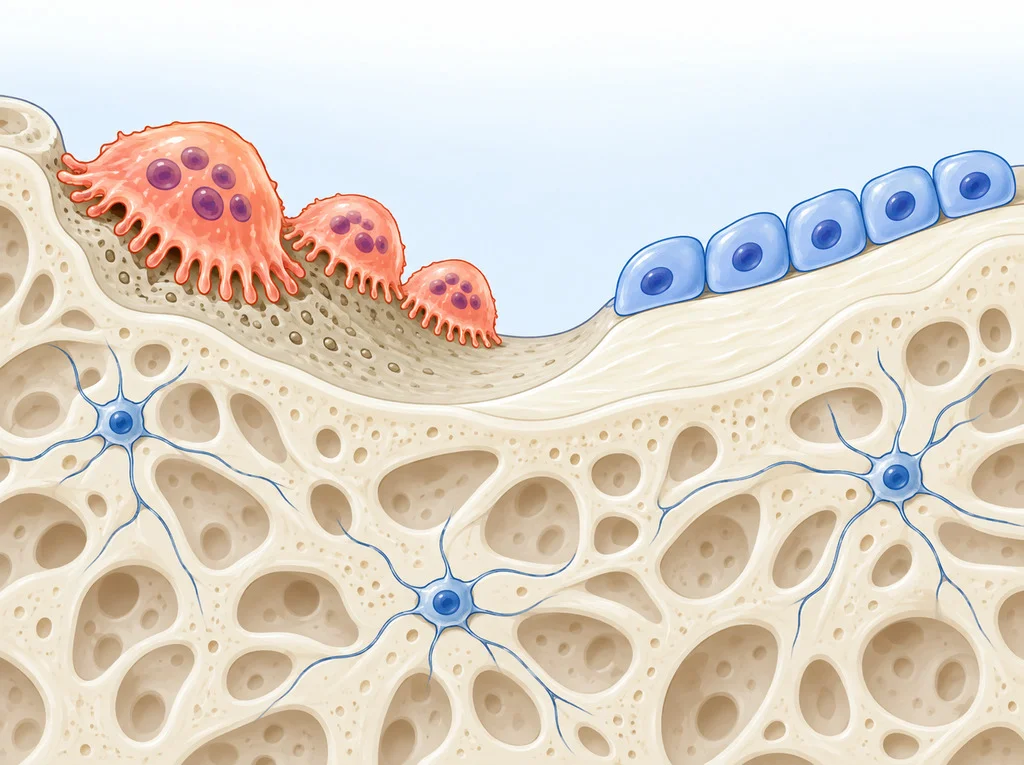
Bone is worked on constantly by two crews of cells that do opposite jobs.
- cells that dissolve and remove small patches of old bone (osteoclasts) clear away old or damaged bone.
- cells that lay down new bone in the space that was cleared (osteoblasts) fill the space back in with new bone.
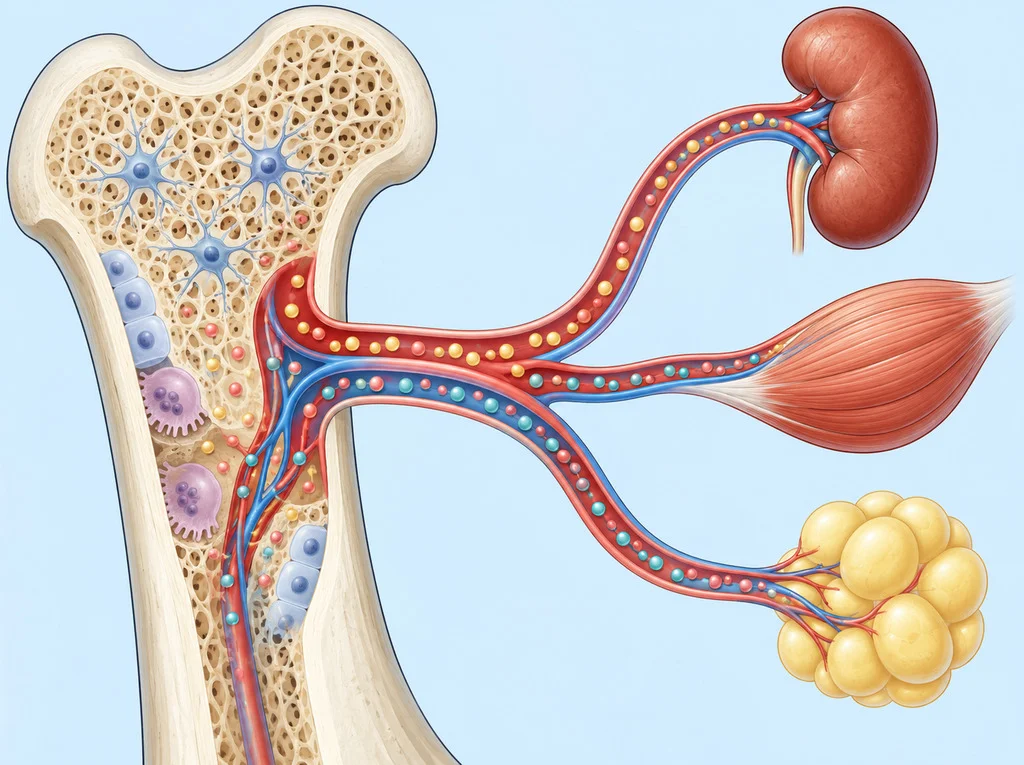
A third kind, the osteocyte, sits buried inside the mineral in a network of tiny channels, sensing load and telling the other two where work is needed. The three talk to each other constantly, by direct contact and by chemical signals.
The result is that the skeleton you have now is not the one you were born with, or even the one you had a few years ago. It is the same shape, continuously renewed — more like a road that is endlessly resurfaced than a building that is put up once.
This is also why a broken bone can heal into something as strong as it was before. The machinery for making new bone never left.
The body’s calcium account
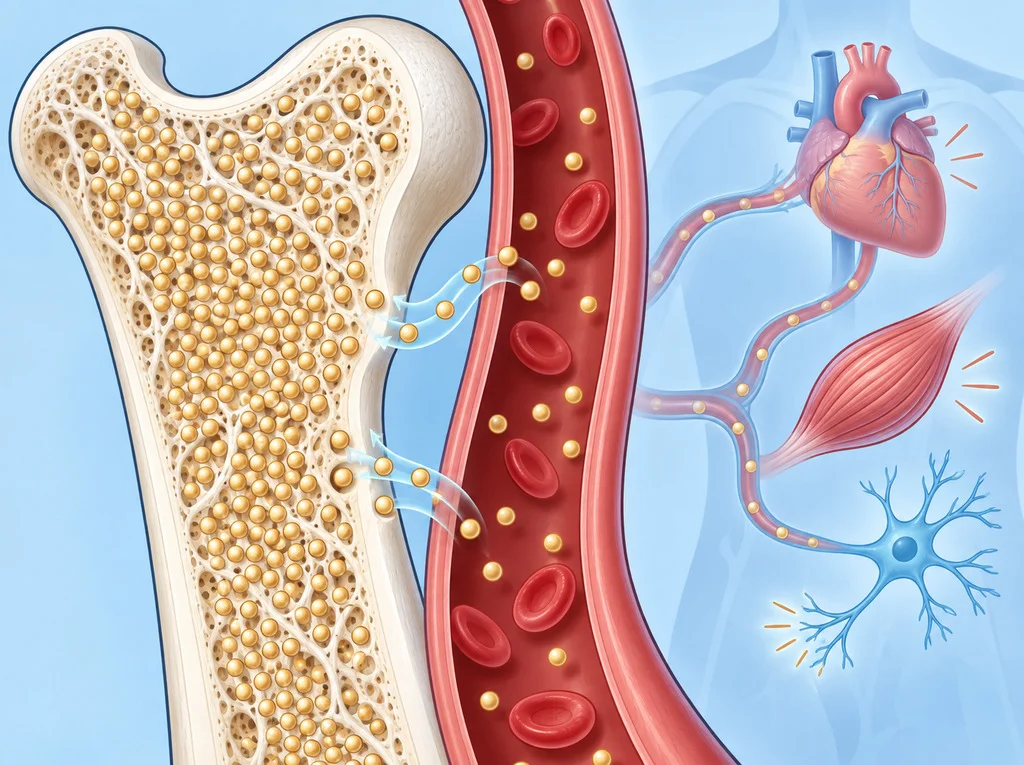
Your muscles cannot contract, your nerves cannot fire and your heart cannot keep its rhythm without calcium in the blood held within a narrow range. The body defends that range fiercely.
Bone is where the reserve is kept. The great majority of the body’s calcium sits in the skeleton, and when blood levels drop, hormones instruct bone to release some of it. When there is plenty, some goes back.
That is a sensible design with one uncomfortable consequence: the skeleton is the account that gets drawn on. If calcium and vitamin D are short for years, the withdrawals are still made — quietly, without symptoms, from your own structure.
There is a factory inside
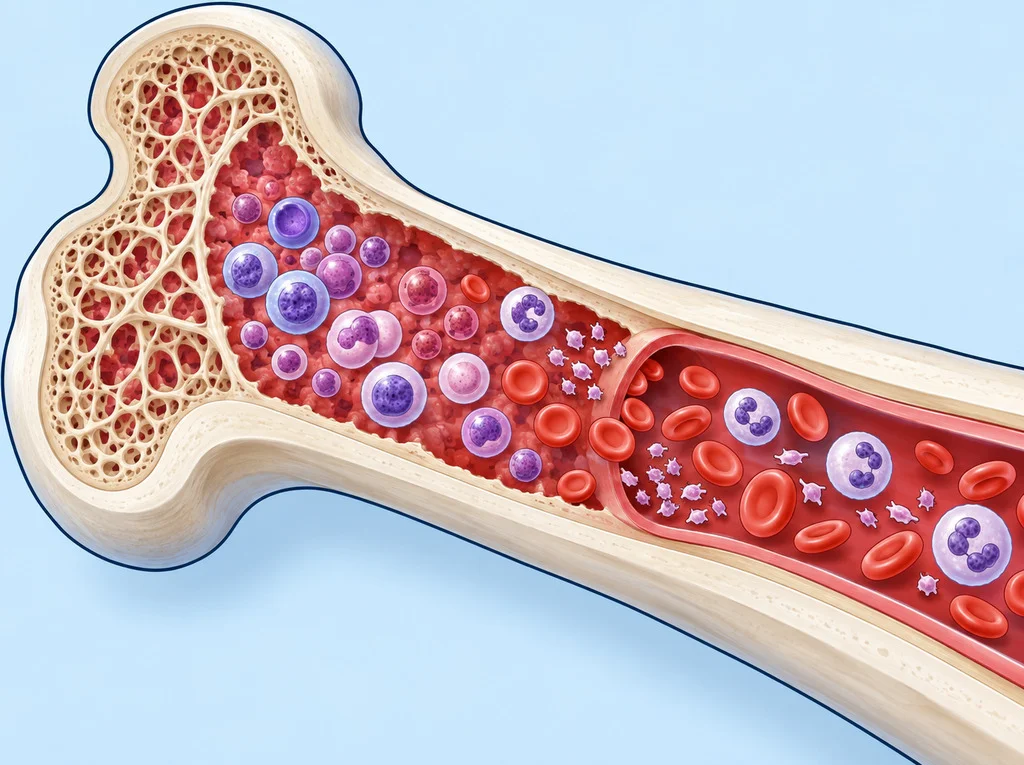
The space in the middle of many bones is not empty. It holds bone marrow (bone marrow), where red blood cells, white blood cells and platelets are made — the cells that carry oxygen, fight infection and stop bleeding.
So the skeleton is not only holding you up. It is also the site of one of the body’s essential manufacturing processes.
It sends messages to other organs
This is the part that surprises most people, and it is relatively recent knowledge.
Bone releases substances into the bloodstream that act elsewhere in the body — which is the definition of an endocrine organ. Reviews of bone metabolism describe bone-derived signals acting on the kidney to regulate phosphate, and on the handling of sugar and energy. Bone, muscle and fat also send signals to one another, which is part of why they tend to weaken together and strengthen together.
The practical version: your skeleton is not off in a corner doing structural work. It is wired into the rest of you.
Looking after it
None of this is complicated, and most of it is free.
- Load it. Bone adds material where it is used. Walking, stair climbing, dancing and resistance work with weights or bands all count as loading; swimming and cycling are excellent exercise but put much less load through the skeleton. Variety helps.
- Keep the muscle. Muscle pulls on bone, and the two decline together. Strength work is bone work.
- Eat for it. Calcium from food, enough protein, and vitamin D. Whether you need a supplement — and how much — depends on your diet, your blood tests and your other medicines, so ask your doctor or pharmacist rather than guessing.
- Do not smoke, and go easy on alcohol. Both are established risks to bone.
- Protect against falls. The strongest bone in the world does not help if you land badly. Lighting, floor clutter, footwear and balance training all matter, particularly later in life.
- Ask about your medicines. Some long-term medicines affect bone. That is not a reason to stop one — it is a reason to mention it at your next appointment.

When to see a doctor
Bone loss itself causes no symptoms until something breaks, which is exactly why it is worth asking about rather than waiting to feel it. The osteoporosis article covers who is usually checked and how, and bone density scans explains the test.
Questions to ask your doctor
- Am I in a group that should have bone density checked, and when?
- Do any of my medicines or conditions affect my bones?
- What kind of exercise would be safe and useful for me specifically?
- Am I getting enough calcium and vitamin D from what I eat?
- What can I do about my risk of falling?
Frequently asked questions
Is bone alive?
Yes. Bone contains living cells, its own blood supply and nerves. The hard mineral is only part of it — the rest is a living framework that is taken apart and rebuilt continuously.
If bone rebuilds itself, why does it get weaker with age?
Rebuilding has two halves: cells that remove old bone and cells that lay down new bone. They stay roughly in balance for much of life. When removal starts to outpace formation — with age, after menopause, or with some medicines and illnesses — the total slowly falls.
Does exercise really change bone?
Bone responds to being loaded. Weight-bearing and resistance exercise are part of standard advice for bone health, which is why people on long bed rest or in weightlessness lose bone. How much any one person gains varies, and it is not a substitute for treatment when treatment is needed.
Should I take a calcium or vitamin D supplement?
That depends on your diet, your blood levels, your kidneys and what else you take, so it is a question for your doctor or pharmacist rather than something to decide from a page. Food sources are the usual starting point.
References
- Florencio-Silva R et al. Biology of Bone Tissue: Structure, Function, and Factors That Influence Bone Cells. Biomed Res Int. 2015
- Kim JM et al. Osteoblast-Osteoclast Communication and Bone Homeostasis. Cells. 2020
- Marsot C et al. Bone and metabolism. Ann Endocrinol (Paris). 2018
- Kirk B et al. Muscle, Bone, and Fat Crosstalk: the Biological Role of Myokines, Osteokines, and Adipokines. Curr Osteoporos Rep. 2020
- Rachner TD, Khosla S, Hofbauer LC. Osteoporosis: now and the future. Lancet. 2011
Related conditions
Written by Assoc. Prof. Sorawut Thamyongkit, M.D.