
Tennis elbow
Pain over the bony point on the outer side of the elbow, from overloading the tendon of the muscles that lift the wrist. It is not confined to tennis players, and most cases settle.
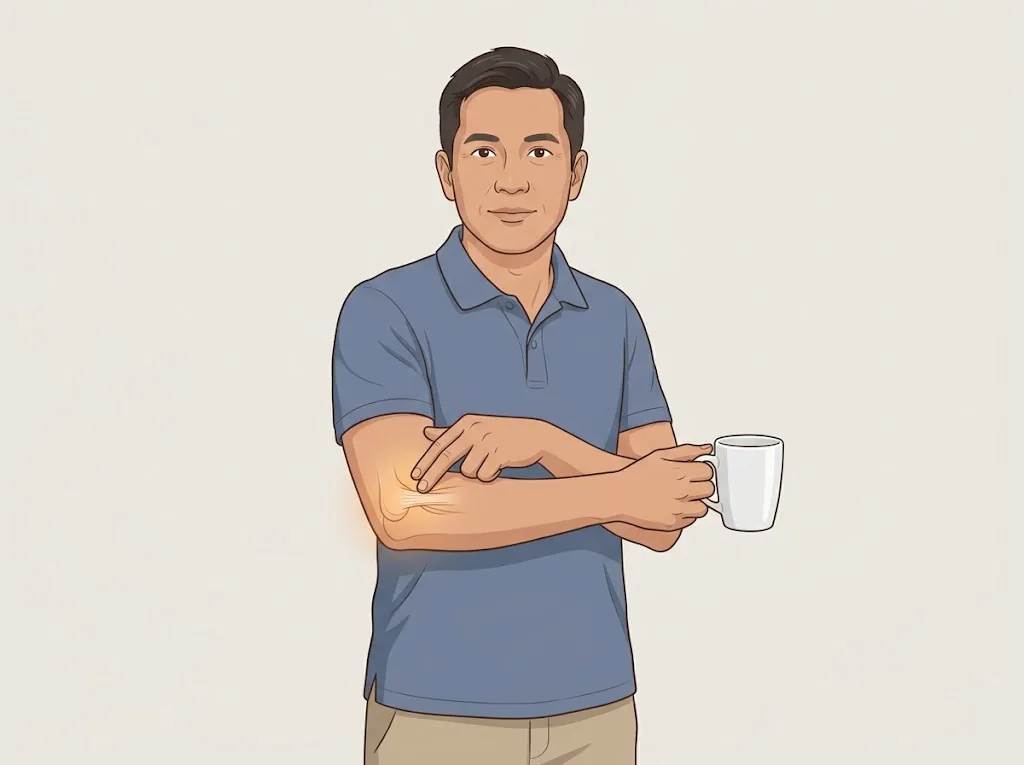
What it is
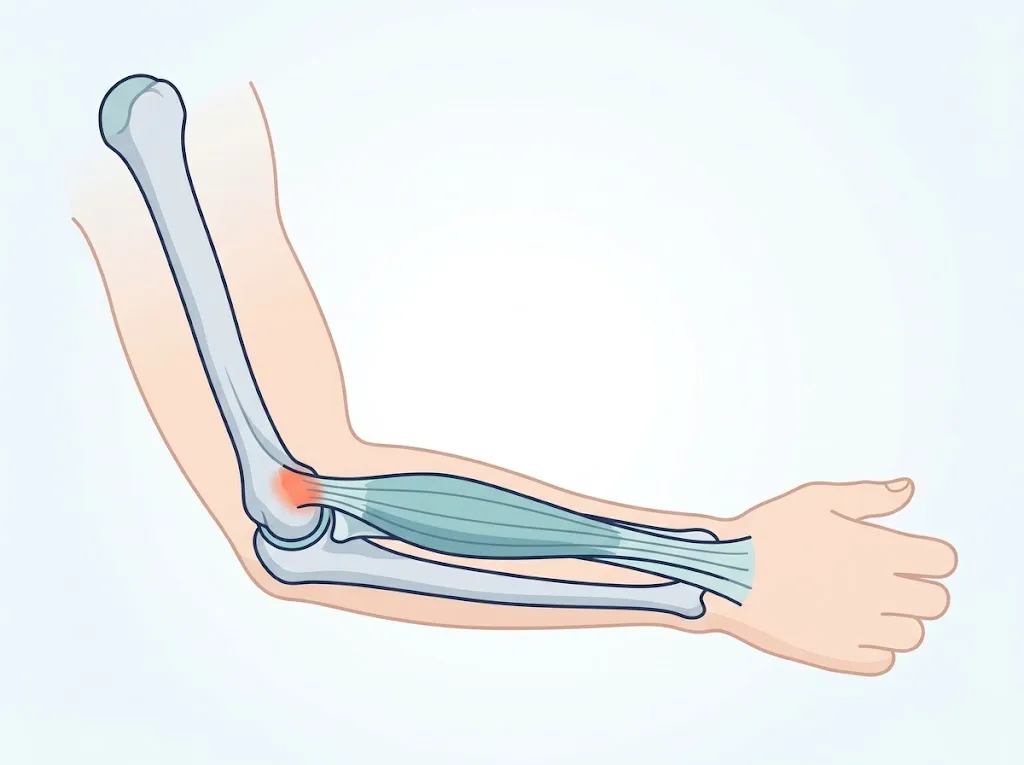
The muscles that lift your wrist and straighten your fingers sit on the outer side of the forearm. Their upper ends converge into a single tendon that attaches to the bony point on the outer side of the elbow.
Every time you grip, lift, turn a doorknob or use a mouse, those muscles work to steady the wrist. All that force passes through one small attachment point.
When the load exceeds what the tendon can adapt to, the tissue at that attachment begins to degenerate and the fibres lose their orderly arrangement. That is what is called tennis elbow.
Symptoms
- Pain right over the bony point on the outer elbow, tender at one clear spot
- Pain spreading down the outer forearm towards the wrist
- Worse gripping, lifting, turning a doorknob, wringing out a cloth, or shaking hands
- Worse lifting the wrist against resistance — picking up a kettle or a coffee cup
- Grip strength drops, usually because of the pain rather than true muscle weakness
- Usually no swelling or redness, and the elbow still bends and straightens fully
Causes and risk factors
- Work involving repeated gripping, twisting or lifting the wrist — carpenters, mechanics, cooks, typing, housework
- A sudden increase in a new activity — starting gardening, painting the house, or picking up a racket sport
- Unsuitable equipment or technique — handles that are too small, a racket that is too heavy or strung too tightly
- Age 35–55
- Smoking, and conditions such as diabetes
When to see a doctor
Otherwise, see a doctor if it has not improved after six to eight weeks of adjusting activity and exercise, if it stops you working, or if both elbows hurt.
How it is diagnosed
The history and examination are usually enough. Your doctor presses to find the tender point on the outer elbow, then asks you to lift the wrist or straighten the middle finger against resistance, which reproduces the pain in the same place.
They will also check the neck and the nerves, because pain over the outer elbow occasionally comes from a nerve in the neck, or from a nerve compressed in the forearm.
X-ray is not needed in most people. It is used when arthritis is suspected or there has been an injury.
Ultrasound or MRI is used for people who are not improving as expected, or when a tear in the tendon is suspected.
Treatment options
Non-surgical treatment
Most people get better without surgery, though it takes time.
Adjust activity. Cut back what provokes it for a while, but do not stop using the arm altogether, because rest alone weakens the tendon.
Loading exercise with a slow lowering phase is the treatment with the best evidence, and it is what actually changes the tissue.
Change tools and technique. Use thicker handles, lighter equipment, and lift with the palm facing up rather than down.
An elbow strap placed about 2 to 3 cm below the tender point reduces pain for some people. Use it alongside the exercises.
Pain relief for a short period so you can start exercising. Always ask a doctor or pharmacist first.
A steroid injection reduces pain in the short term, but longer-term outcomes may be worse than not injecting, and there is a risk to the tendon — so it is not a first-line treatment. It is your doctor’s decision.
Surgery
Uncommon. Your doctor considers it after at least six to twelve months of thorough non-surgical treatment when pain still interferes with work. The operation removes the degenerate tissue and repairs the attachment, and recovery takes several months.
Recovery and rehabilitation
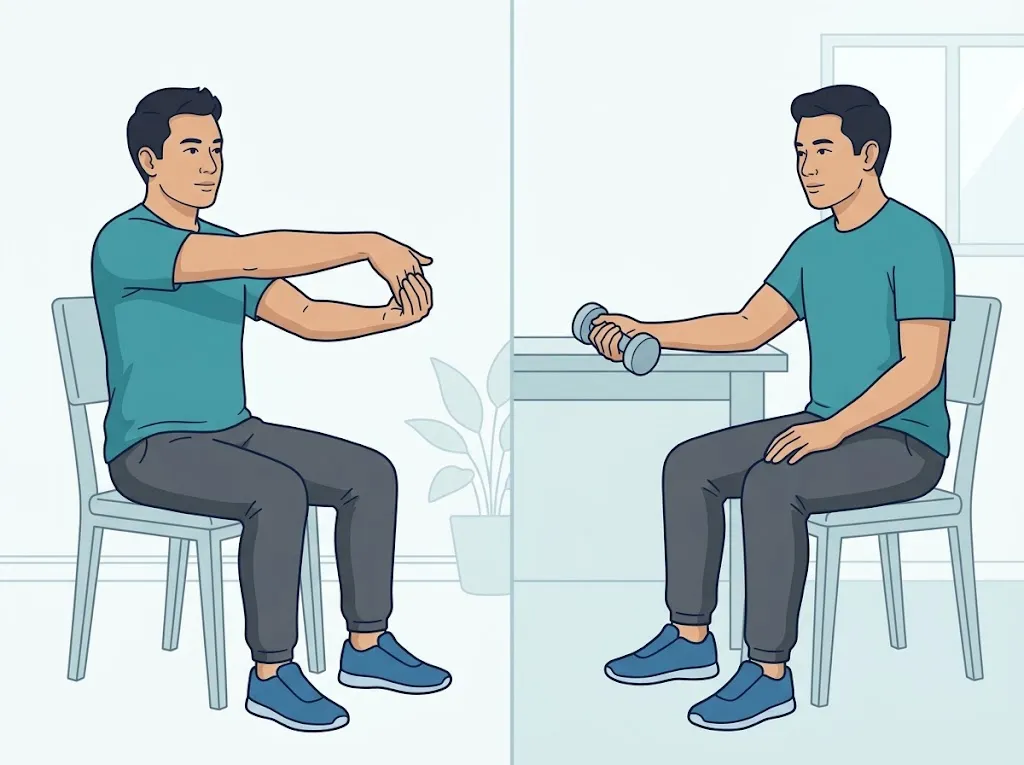
Do these once a day for at least 12 weeks. Pain during the exercise at a tolerable level is acceptable, provided it has settled by the next morning.
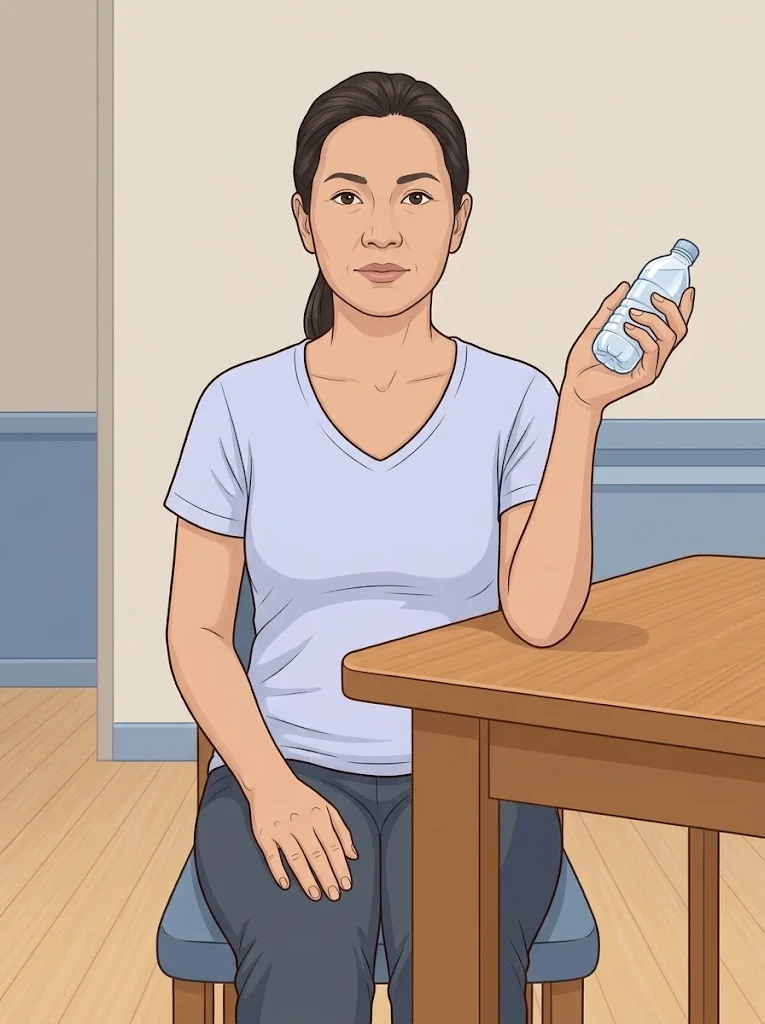
Eccentric wrist extension
3 rounds · 15 times
Sit with the forearm resting on a table, palm down and the wrist over the edge, holding a light weight. Use the other hand to lift the wrist all the way up, then let go and lower it slowly on its own over 3 seconds.
Watch for — the lowering is the point, not the lifting. Start very light, such as a small water bottle.
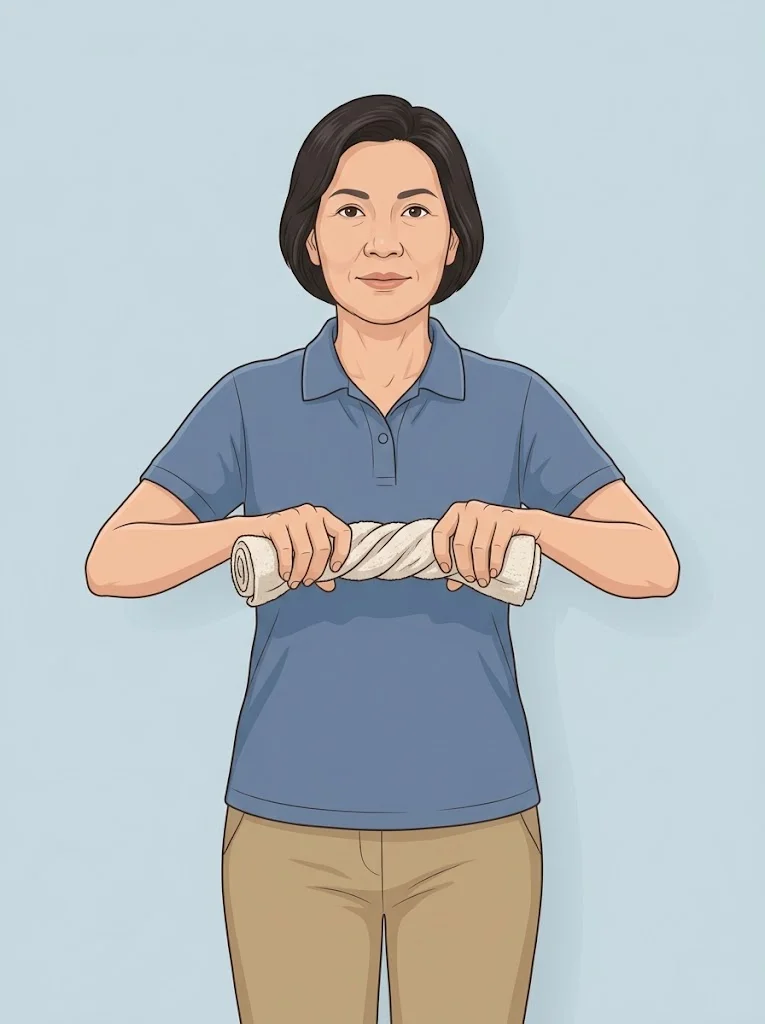
Towel twist
3 rounds · 10 times
Hold a rolled towel in both hands and twist it slowly in opposite directions as if wringing it out, then unwind slowly.
Watch for — let the unwinding be slower than the twisting.
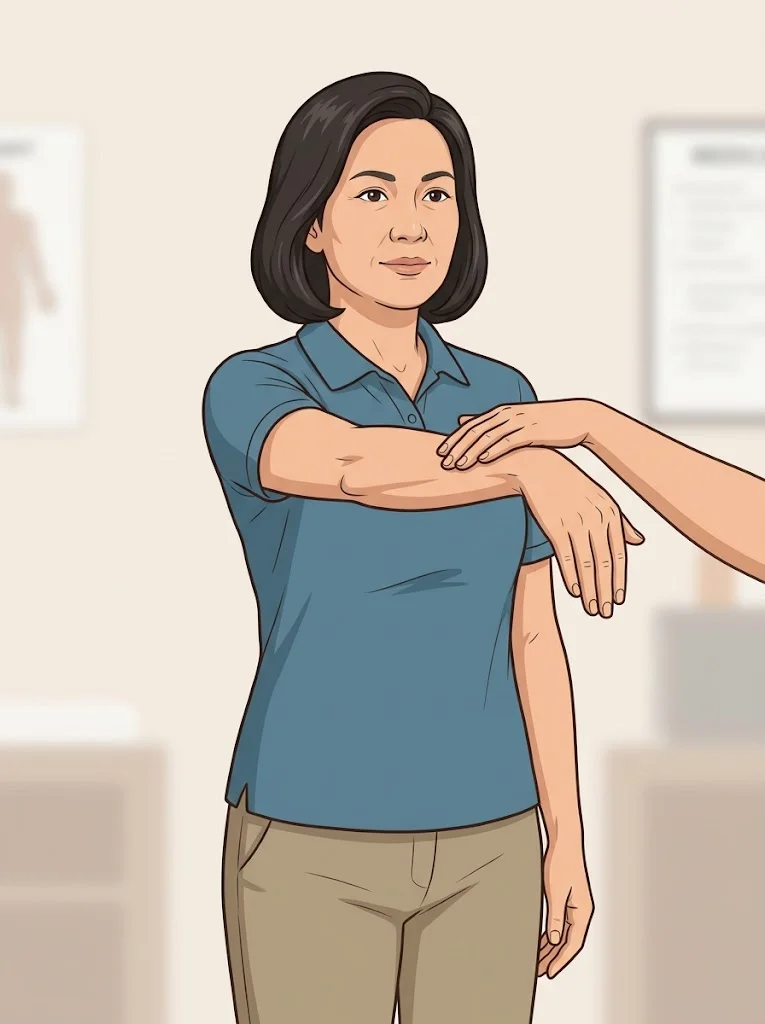
Forearm extensor stretch
3 each side · hold 30 seconds
Straighten the affected arm in front of you, palm down, and use the other hand to press the back of the hand downward until you feel a stretch along the outer forearm.
Watch for — do this before and after every session.
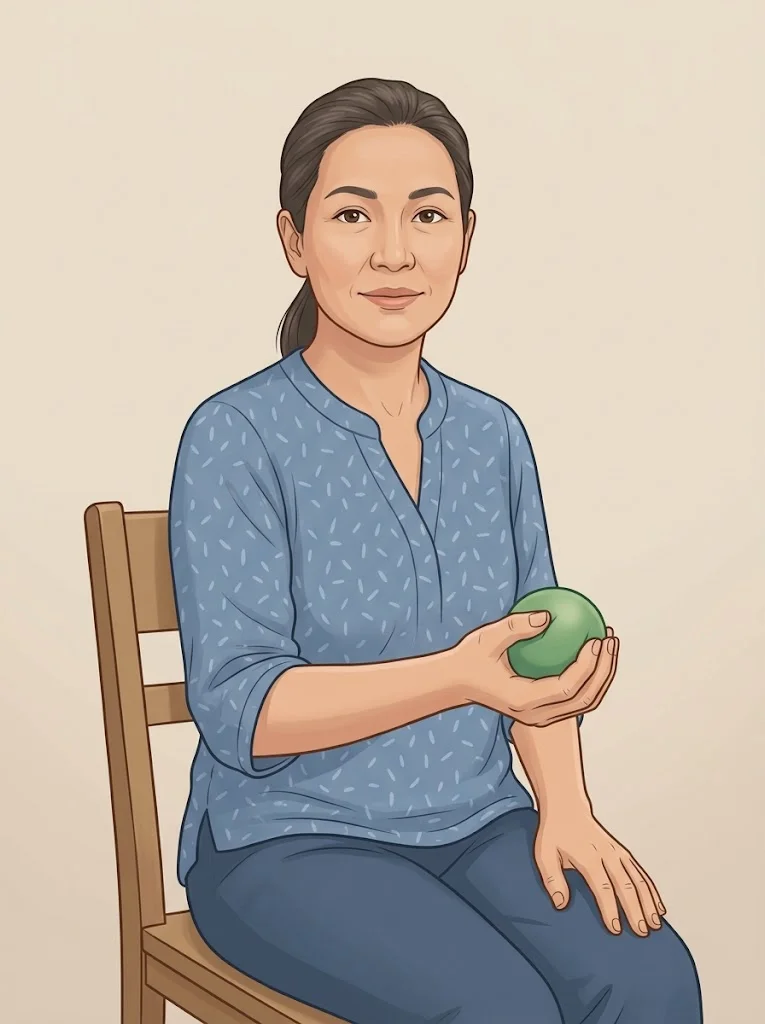
Soft ball squeeze
3 rounds · 15 times · hold 3 seconds
Hold a soft ball or rolled towel and squeeze, hold 3 seconds, then release. Do it with the elbow slightly bent and the palm facing up.
Watch for — if squeezing with the palm down hurts more, start palm up.
Prevention and self-care
- Lift with the palm facing up rather than down, which reduces the pull on the attachment
- Use thicker, softer handles on tools you use often
- Take a break and change position every 30–60 minutes during repetitive gripping or twisting
- Increase new activities gradually, especially one-off whole-day jobs like painting or gardening
- Strengthen the forearm and shoulder, because a strong shoulder reduces the load on the elbow
- Set your desk up with the elbow supported and the wrist straight
Questions to ask your doctor
- Is my pain really from the tendon attachment, or could it be coming from my neck or a nerve?
- What should I cut back, and for how long?
- Which exercises should I do, how often, and with how much weight?
- Would an elbow strap help me, and where should it sit?
- How long should I follow the programme before judging whether it works?
Frequently asked questions
I do not play tennis, so why do I have it?
The name comes from where it was first described, but most people who get it have never played tennis. Far more common are jobs involving repeated gripping, twisting or lifting the wrist — carpenters, mechanics, cooks, people who type a lot, and people doing housework.
Should I stop using the arm?
Not completely. Rest alone tends to weaken the tendon, and the pain comes back when you start using it again. Cut back what provokes it for a while, then start a loading programme with a slow lowering phase.
Does an elbow strap help?
It reduces pain for some people in the short term by spreading the pull away from where the tendon attaches. Put it about 2 to 3 cm below the sore point, and use it alongside the exercises rather than instead of them.
How long does it take?
Most people improve within six months to a year even without doing anything special, but consistent exercise makes it faster and reduces the chance of recurrence. Consistency matters more than intensity.
References
Related educational reading
These pages explain tests, treatments and rehabilitation that often come up with this condition. They are general reading, not a treatment sequence arranged for you — that has to come from a doctor who has examined you.
Treatment
Related conditions
Written by Assoc. Prof. Sorawut Thamyongkit, M.D.