
Achilles tendinopathy
The Achilles tendon degenerates under repeated load, causing pain and stiffness at the back of the ankle, worst when starting to move. Loading exercise is the main treatment.
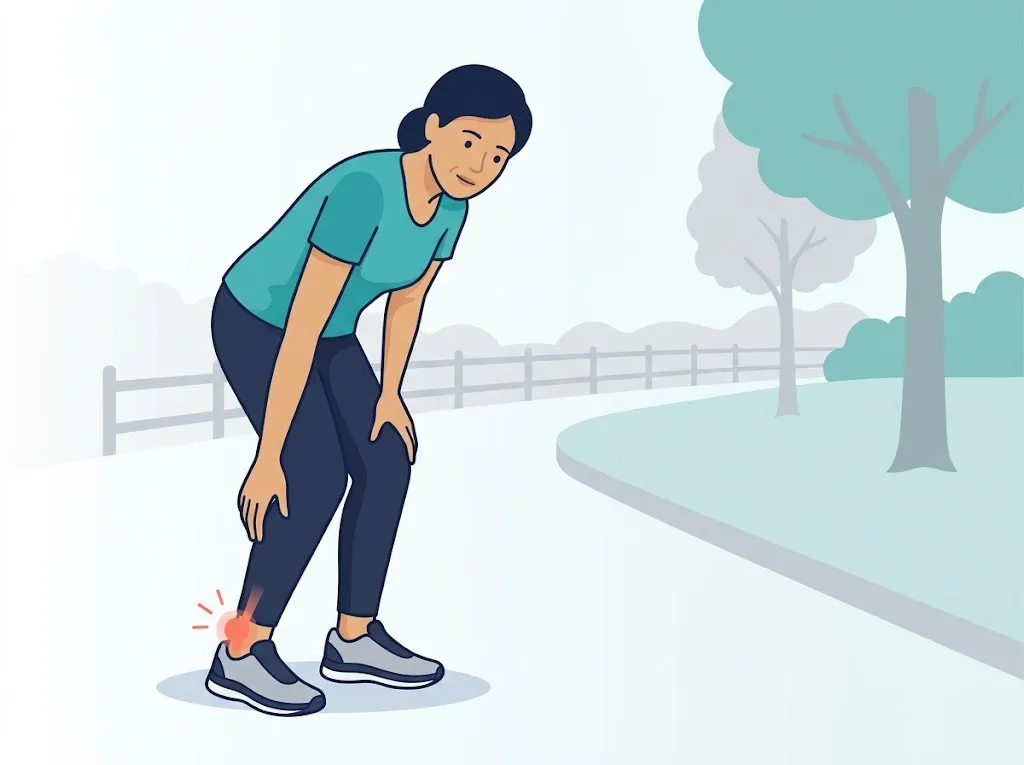
What it is
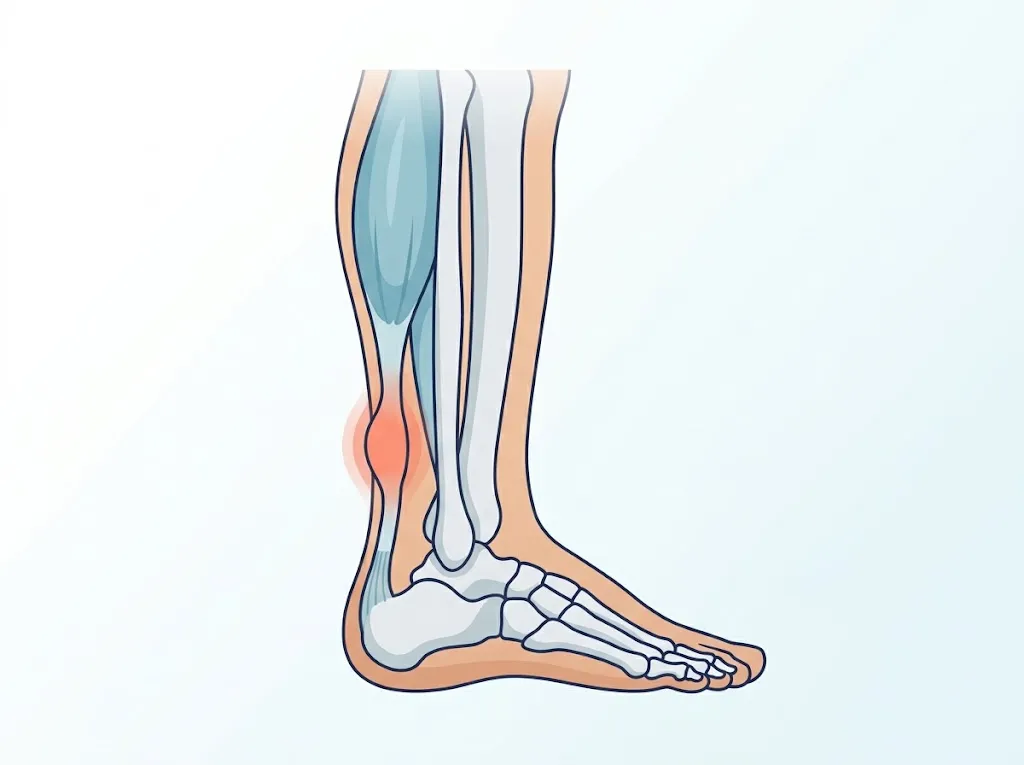
The Achilles tendon joins the calf muscles to the heel bone, transmitting force from the calf to the ground every time you rise onto your toes, walk or run. It takes several times your body weight with each running stride.
When the load exceeds what the tendon can adapt to, the tissue begins to degenerate: the fibres lose their orderly arrangement and the tendon thickens. This state is called tendinopathy.
There are two locations, managed slightly differently:
- Mid-portion — pain 2 to 6 cm above the heel. The commonest
- Insertional — pain right where the tendon attaches to the heel bone. This one is sensitive to deep stretching and to shoes that press on the back of the heel
Symptoms
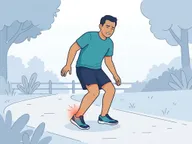
- Pain and stiffness at the back of the ankle, especially first thing in the morning and when starting exercise
- Eases once you are warmed up, then hurts more afterwards or the next day
- The tendon thickens and is tender, and you can often feel a firm lump along it
- Slight swelling around the tendon
- Pain rising onto your toes, with less push-off power
Causes and risk factors
- Increasing running distance or pace too quickly — the commonest cause
- Tight calves and limited ankle bend
- Carrying extra weight
- Age 30–50
- Diabetes, high blood lipids, and some inflammatory arthritis
- Unsuitable or worn-out shoes
- Fluoroquinolone antibiotics, which raise the risk of tendon problems. If Achilles pain starts while you are taking one, speak to your doctor
When to see a doctor
Otherwise, see a doctor if it has not improved after eight to twelve weeks of adjusting activity and loading exercise.
How it is diagnosed
The history and examination usually suffice. Your doctor feels for the tender area and the thickness of the tendon, checks how tight the calf is, sees whether you can rise onto that toe alone, and squeezes the calf to test whether the tendon is still connected.
Ultrasound shows tendon thickening and degeneration well, and can be done while the ankle moves.
MRI is used when a partial tear is suspected, or when surgery is being considered.
X-ray shows calcification at the insertion or a heel bump in the insertional type.
Treatment options
Non-surgical treatment
Loading exercise is the main treatment and has the best evidence. The key is the slow lowering phase, which is what stimulates the tendon to rebuild.
Adjust activity rather than stopping. Reduce to a level where pain stays tolerable and settles by the next day, then build back up.
A heel raise inside the shoe reduces tension on the tendon while it is very painful. Use it temporarily and then stop.
Footwear. Avoid shoes whose back edge presses on the tender point, especially in the insertional type.
Pain relief for short periods. Always ask a doctor or pharmacist first.
Other treatments such as shockwave are your doctor’s decision for pain that drags on. Doctors generally avoid injecting steroid into the tendon itself, because it raises the risk of rupture.
Surgery
Uncommon. Your doctor considers it after at least six months of thorough non-surgical treatment when pain still limits daily life — or in the separate situation of a complete rupture.
Recovery and rehabilitation
Programmes take at least 12 weeks. Pain during the exercise at a tolerable level is acceptable, as long as it has settled by the next morning.
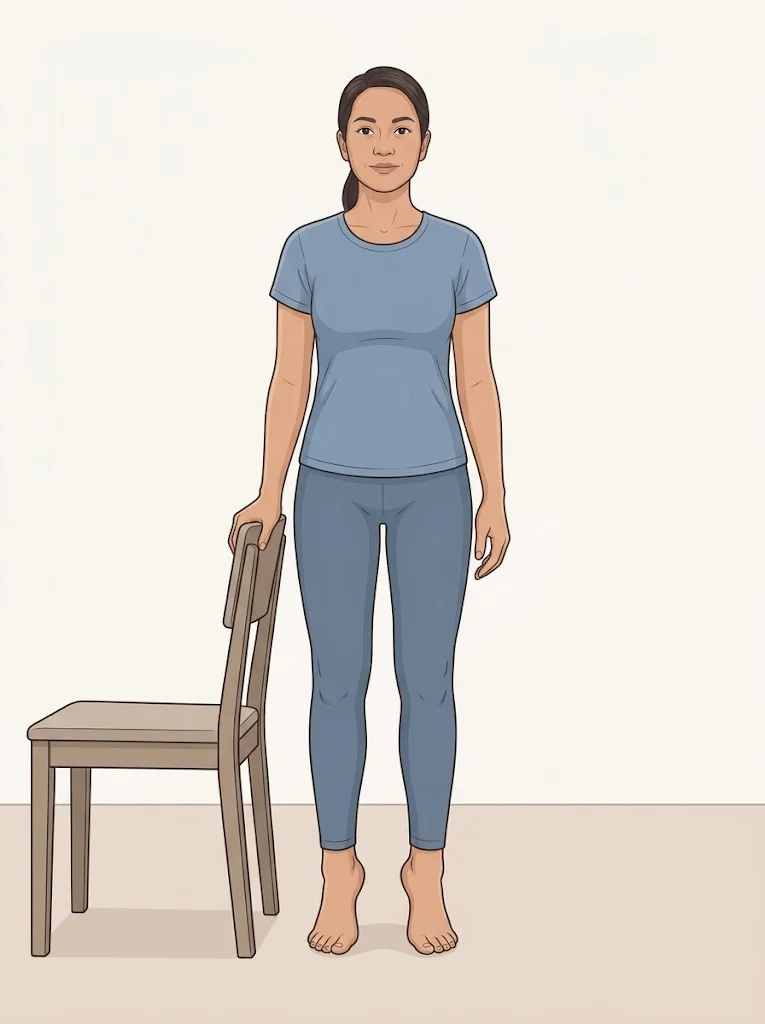
Double-leg heel raise on the floor
3 rounds · 15 times
Hold a chair back. Rise onto your toes over 3 seconds, hold 2 seconds, then lower over 3 seconds.
Watch for — start here for the first two weeks. The lowering is always slower than the rising.
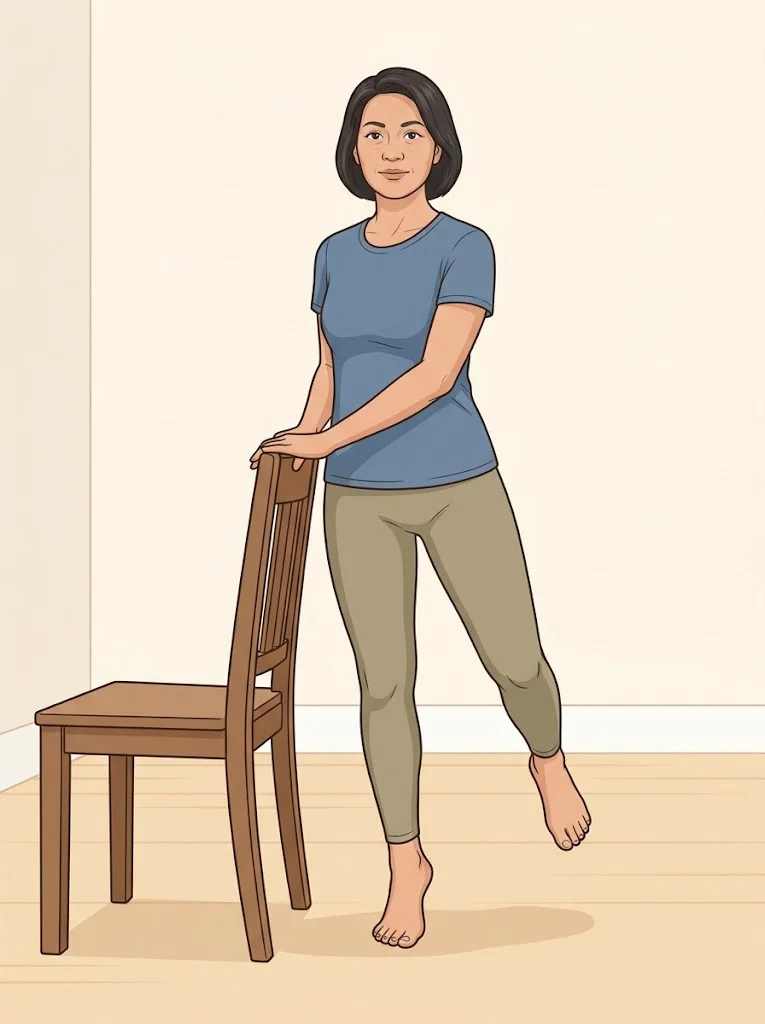
Single-leg heel raise
3 rounds · 12 times
Hold a chair back and lift the other foot. Rise onto the toes of the affected leg slowly, then lower slowly over 3 seconds.
Watch for — move on to this once the double-leg version is comfortable.
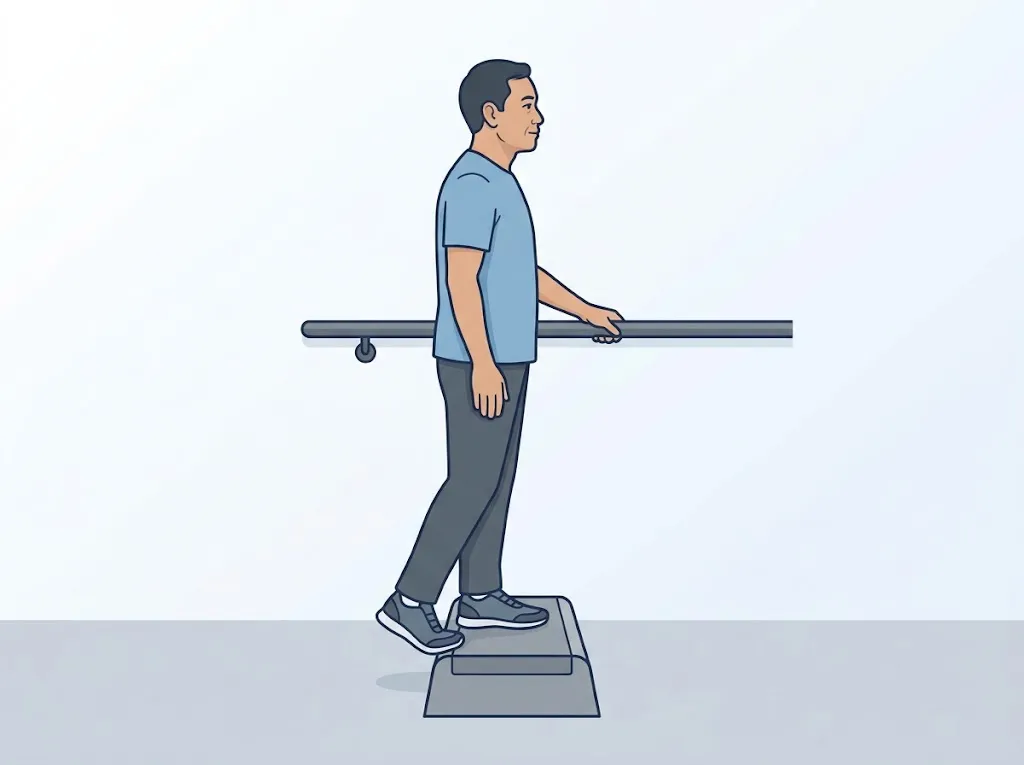
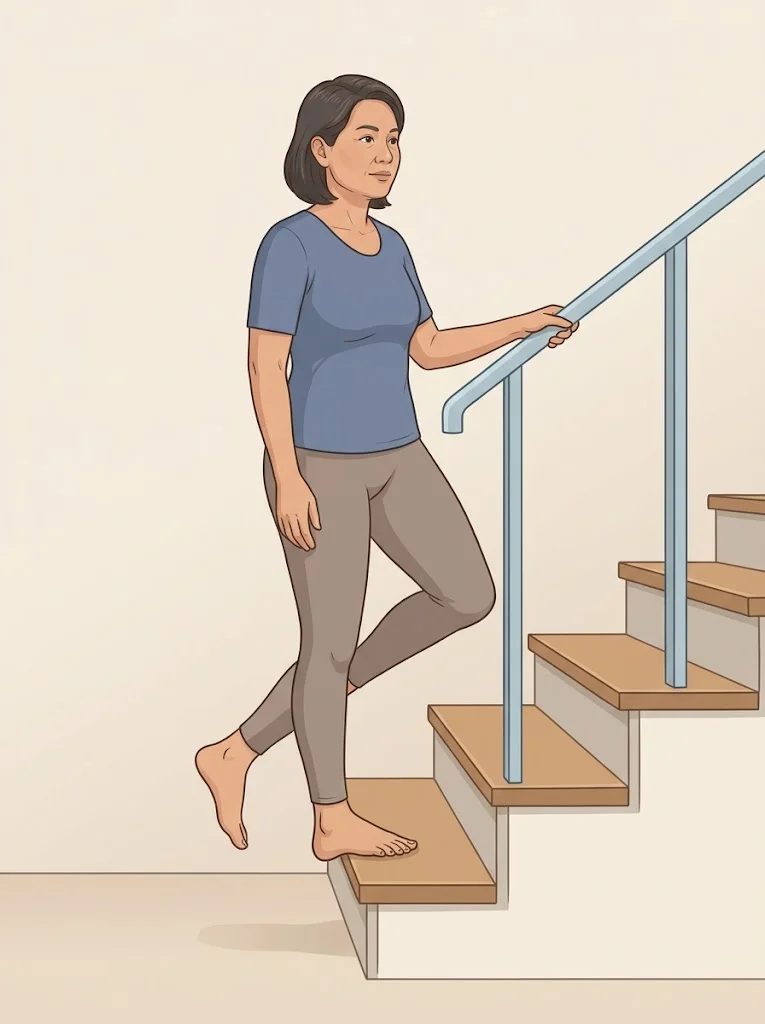
Heel drop from a step
3 rounds · 12 times
Stand on the edge of a step with your heels over the edge, holding the rail. Rise up on both legs, then take the good leg off and lower the affected heel slowly below the level of the step over 3 seconds.
Watch for — this is for the mid-portion type. If your pain is right where the tendon meets the heel bone, do this on flat ground instead, because dropping below the step compresses the sore spot.
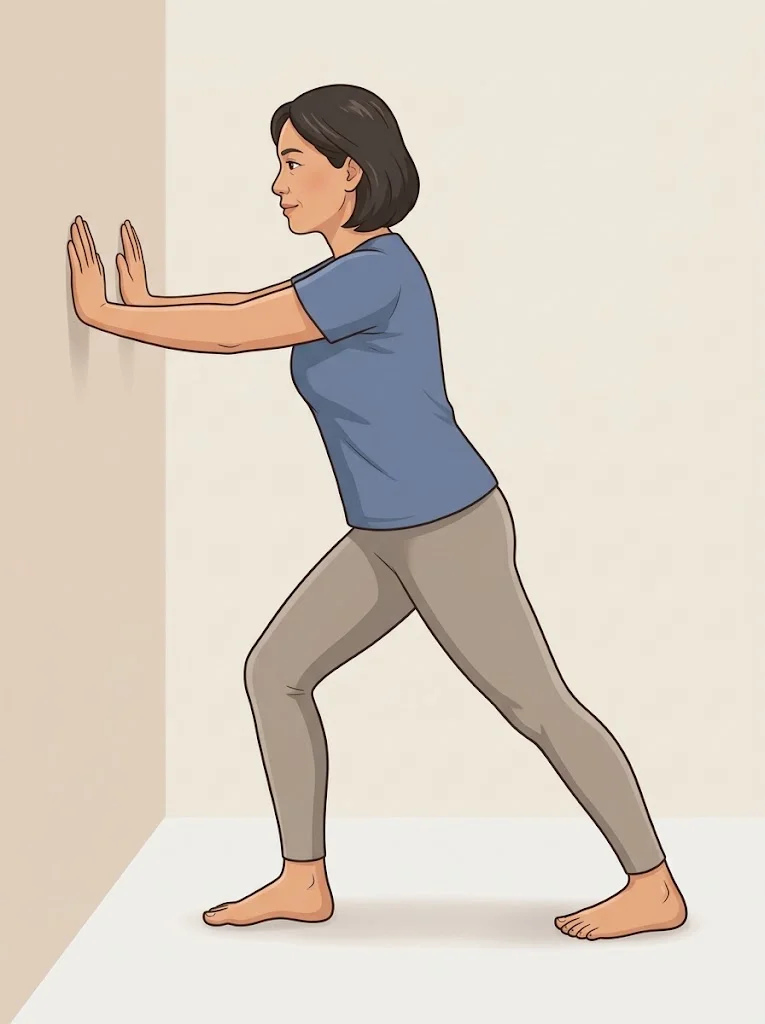
Calf stretch against a wall
3 each side · hold 30 seconds
Face a wall with both hands on it, step the affected leg back with the knee straight and the heel flat, and lean in until you feel a stretch. Repeat with the back knee slightly bent.
Prevention and self-care
- Increase distance and pace gradually, by no more than about a tenth a week, and never both at once
- Stretch the calves and practise heel raises regularly, even when nothing hurts
- Warm up for at least 10 minutes before exercise
- Replace shoes when the soles wear, and avoid ones whose back edge presses on a sore spot
- Be careful changing running surface suddenly — from a track to hills or sand, for instance
- Keep weight, blood sugar and blood lipids in a healthy range
Questions to ask your doctor
- Is mine the mid-portion or the insertional type, and how do the exercises differ?
- Is there a partial tear in my tendon?
- How much should I cut back, and when can I build up again?
- Should I use a heel raise, and for how long?
- How long should I follow the programme before judging whether it works?
Frequently asked questions
Do anti-inflammatory tablets help?
They help the pain a little in the short term, but the underlying problem is degeneration of the tendon rather than inflammation, so they are not the main treatment. Loading exercise is what actually changes the tissue.
Should I stop running?
Usually not completely. Reduce distance and pace to a level where the pain stays tolerable and settles by the next day, then build back. Stopping altogether weakens the tendon and the pain tends to return when you restart.
Is it true you should not inject steroid into the Achilles?
Doctors generally avoid injecting steroid directly into the Achilles tendon, because it raises the risk of rupture. Anything injected there has to be a considered decision by a doctor who has assessed you.
How long until it improves?
Programmes usually need 12 weeks or more before the benefit is clear, and many people take several months. Tendon changes far more slowly than muscle, so consistency matters more than intensity.
References
Related educational reading
These pages explain tests, treatments and rehabilitation that often come up with this condition. They are general reading, not a treatment sequence arranged for you — that has to come from a doctor who has examined you.
Related conditions
Written by Assoc. Prof. Sorawut Thamyongkit, M.D.