
Shoulder pain
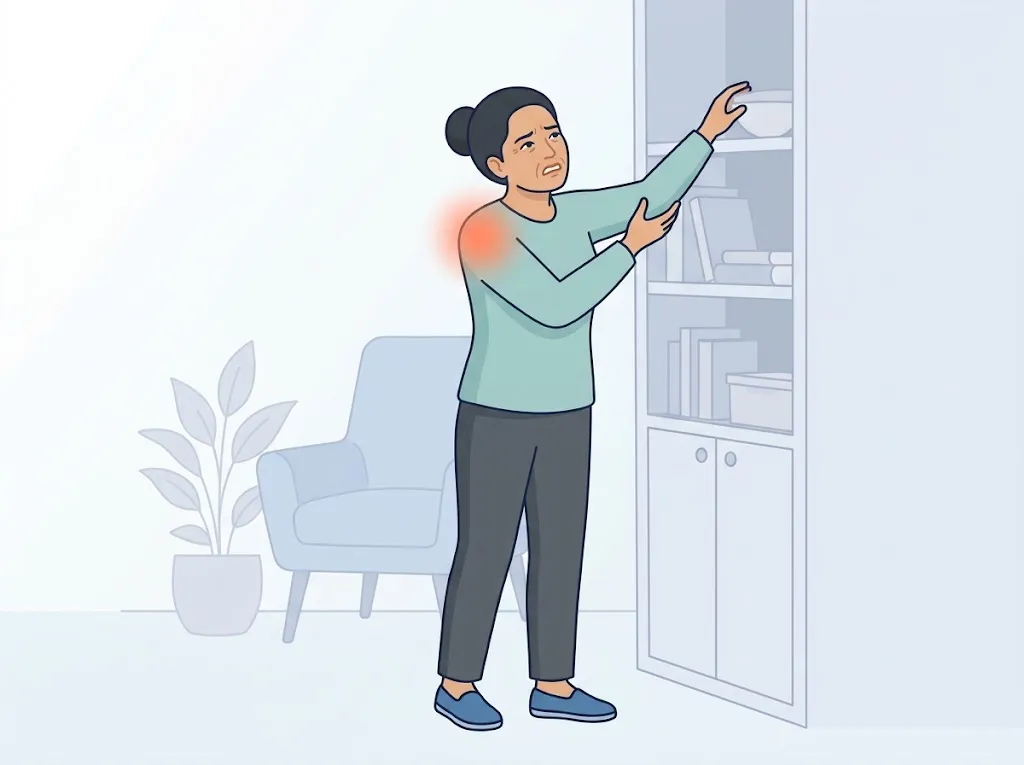
Shoulder pain has several causes — tendons, the joint capsule, the joint itself. Where it hurts, and which movements bring it on, narrows it down. This page helps you describe it accurately to a doctor.
What it is
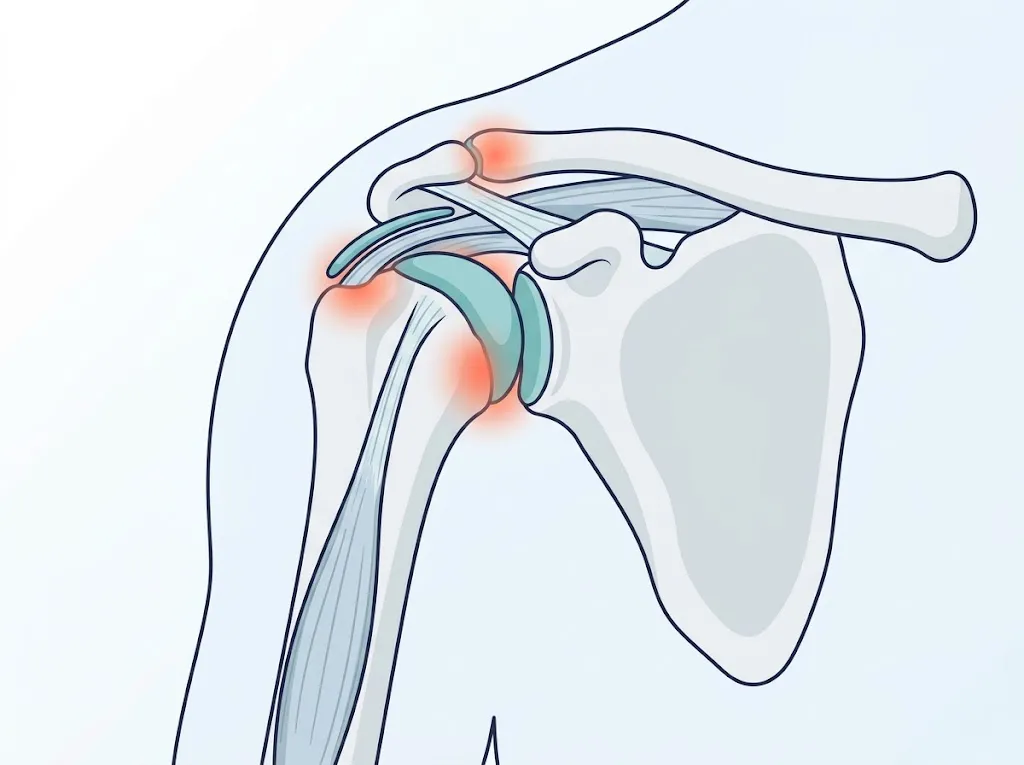
The shoulder is a ball sitting on a shallow socket on the shoulder blade, rather like a golf ball on a tee. That design gives it the widest range of any joint in the body, at the cost of depending on the surrounding tissue to hold it in place.
Four structures cause most shoulder pain:
- The rotator cuff, four muscles and tendons wrapping the top of the joint
- The joint capsule, the sleeve around the joint, which thickens and tightens in frozen shoulder
- The bursa, a fluid-filled cushion above the tendons
- The joints themselves, both the shoulder joint and the small joint between collarbone and shoulder blade
Symptoms
The pattern narrows things down considerably. You do not need to diagnose yourself, but noticing these makes your description to a doctor far more useful.
| What you notice | May be related to |
|---|---|
| You cannot lift the arm yourself, but if someone lifts it for you it goes much further | A rotator cuff problem |
| Movement is limited both when you move it and when someone else does, especially rotating outward | Frozen shoulder |
| Pain right on top of the shoulder near the collarbone, worse reaching the arm across your chest | The collarbone–shoulder blade joint |
| Neck pain as well, pain spreading past the elbow, or numb fingers | Possibly the neck rather than the shoulder |
| Pain after a fall or a yank on the arm, and you cannot lift it at all | An acute injury — see a doctor |
Causes and risk factors
Roughly by age group:
- Under 30 — sports injuries, dislocation, or an unstable joint
- 30–50 — rotator cuff tendons pinched or irritated by repeated use, and frozen shoulder
- Over 50 — rotator cuff wear or tearing, and shoulder arthritis
Things that raise the chance: work or sport with repeated overhead reaching, smoking, diabetes, thyroid disease, and a period where the shoulder did not move after an injury or an operation.
When to see a doctor
Otherwise, see a doctor when shoulder pain lasts more than two or three weeks without improving, when night pain keeps you awake, or when you start avoiding that arm in everyday tasks.
How it is diagnosed
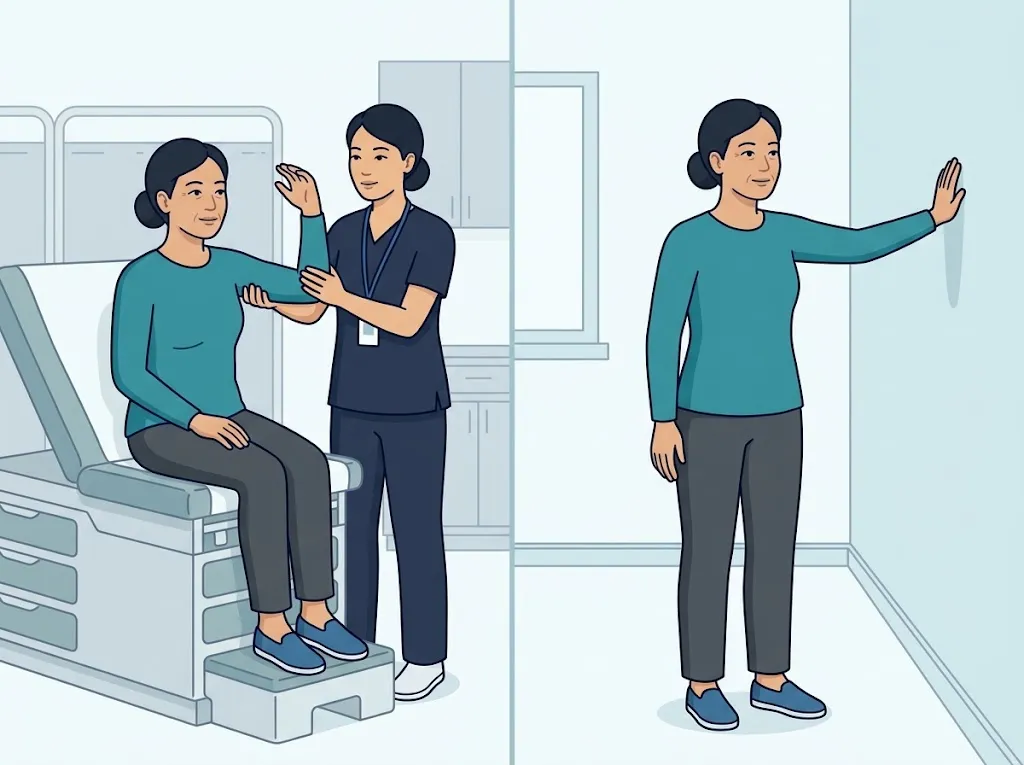
Your doctor starts with the history — where it hurts, what brings it on, when it started, and whether anything happened first. Then an examination: measuring how far the arm moves when you move it and when they move it, testing the strength of each muscle, and checking the neck too, in case the pain is coming from there.
X-ray is usually done when arthritis, calcium in a tendon, or a past injury is suspected.
Ultrasound and MRI are not needed in everyone. Several clinical guidelines advise against MRI at the onset of shoulder pain, because it rarely changes early treatment. Your doctor will consider it when things are not improving as expected, or when surgery is on the table.
Treatment options
Non-surgical treatment
Nearly all shoulder pain starts here, whatever the cause.
- Adjust what you do. Cut back overhead work while it hurts, then rebuild gradually
- Keep moving within the comfortable range, so the joint does not stiffen
- Exercise and physiotherapy is the foundation that most clinical guidelines recommend for shoulder pain of any kind, focusing on shoulder blade control and rotator cuff strength
- Pain relief. Paracetamol and non-steroidal anti-inflammatories can let you move and sleep. Always ask a doctor or pharmacist first, particularly with stomach, kidney or bleeding problems, or blood thinners
- Ice or heat, wrapped in a towel, up to 20 minutes. Use whichever feels better
- Injection is your doctor’s decision, usually considered when pain is what is blocking rehabilitation
Surgery
Surgery is not the first answer for general shoulder pain. Your doctor will consider it when there is a clear injury worth repairing — a cuff tendon torn in an accident — or when a proper trial of everything else over several months has not stopped it affecting daily life. Ask what the operation is meant to fix, how long recovery takes, and what happens if you do not have it.
Recovery and rehabilitation
These three are safe for most shoulder pain. Stop at once if you get sharp pain, and if you have just been injured or operated on, follow your doctor’s instructions first.
Pendulum swing
10 each direction
Lean forward with your other hand resting on a table and let the sore arm hang completely loose. Small circles, then small forward-and-back swings.
Watch for — if your shoulder is working, you are doing it too big.
Finger walk up the wall
5 slow reps
Face the wall, put your fingertips on it, and walk them upward until you feel a stretch. Hold, then walk back down.
Watch for — stop at a stretch, not at a sting.
Shoulder blade squeeze
2 rounds · 10 times · hold 5 seconds
Sit or stand tall with arms by your sides. Squeeze your shoulder blades together as if holding a pencil between them, hold, then release.
Watch for — keep your shoulders down, not shrugged, and your neck relaxed.
Prevention and self-care
- Set your desk up so you are not shrugging to reach the keyboard, and get up to change position every hour
- Warm up before heavy shoulder work, particularly overhead
- Break work into spells rather than reaching overhead continuously
- Keep everyday items between waist and shoulder height
- Do not sleep on the painful shoulder. On your back, put a pillow under the forearm
- Strengthen the muscles around the shoulder blade, which reduces pinching of the tendons over time
Questions to ask your doctor
- Which structure is my pain likely coming from, and could it be coming from my neck?
- Do I need any tests, and would the result change how you treat it?
- Which exercises should I do, and which movements should I avoid?
- Should I see a physiotherapist?
- Are the medicines you suggest safe alongside my other conditions?
Frequently asked questions
Is shoulder pain at night a warning sign?
Not necessarily. Night pain is very common in both frozen shoulder and rotator cuff problems. But pain that keeps you awake several nights running, or that is constant even at rest, should be seen by a doctor.
Should I use ice or heat?
For the first few days after an injury, ice usually helps more. For long-standing aching, many people prefer heat. Both are safe wrapped in a towel and used for no more than 20 minutes. Use whichever feels better for you.
Do I need an MRI?
Usually not at first. Several clinical guidelines advise against MRI at the start of shoulder pain, because it rarely changes early treatment. Your doctor will consider it if things do not improve, or if surgery is being discussed.
Should I rest the shoulder or keep moving it?
Keep moving it as much as you comfortably can. Stopping using the arm altogether tends to cause stiffness and muscle wasting. Avoid only the movements that cause sharp pain, and keep moving within the comfortable range regularly.
References
- Lowry V et al. A Systematic Review of Clinical Practice Guidelines on the Diagnosis and Management of Various Shoulder Disorders. Arch Phys Med Rehabil. 2024
- Barrett E et al. Physical Therapy Management of Nontraumatic Shoulder Problems Lacks High-Quality Clinical Practice Guidelines. J Orthop Sports Phys Ther. 2021
Related educational reading
These pages explain tests, treatments and rehabilitation that often come up with this condition. They are general reading, not a treatment sequence arranged for you — that has to come from a doctor who has examined you.
Treatment
Related conditions

Written by Assoc. Prof. Sorawut Thamyongkit, M.D.